




Search
Related News
- 00
0000-00
How nutritional security assessment identifies gaps in local diets - 00
0000-00
How to assess a food packaging technology manufacturer’s line integration capability - 00
0000-00
Which industrial equipment cost factors matter most before approval? - 00
0000-00
What determines the price of an automated feeding system? - 00
0000-00
How to qualify a specialty chemicals manufacturer for food-contact formulations
Tags
Which Certifications Should Buyers Check When Sourcing Agricultural Inputs?




The most reliable way to evaluate certified agricultural inputs is to match the certificate to the product category, the intended use, and the legal market of destination. A valid-looking document is not enough. A seed certificate does not establish fertilizer quality, an organic approval does not confirm pesticide registration, and a laboratory report does not replace a chain-of-custody record.
Approval should begin with a simple question: what claim must this input support? The answer differs when the material will be applied to soil, used on edible crops, incorporated into a regulated production program, or supplied to farms serving export markets. Certification review becomes much stronger when it is tied to the actual risk: contamination, mislabeling, poor germination, prohibited active ingredients, nutrient inconsistency, or loss of traceability.
Start with the certification category, not the certificate design
Agricultural inputs commonly fall into seeds and planting material, fertilizers and soil amendments, crop protection products, biological products, feed-related materials, and post-harvest treatment inputs. Each category has a different evidence path. The relevant certificate should identify the product, issuing body, scope, site or facility, validity period, and, where applicable, the production lot. Documents that only identify a supplier without naming the approved activity leave an important gap.
Third-party certification carries more weight when the issuing organization is recognized by the destination market or by the production scheme being served. Recognition matters because many programs use similar language while applying different inspection rules, residue limits, sampling protocols, or record-retention requirements. A certificate issued for one territory may be commercially useful elsewhere, but it does not automatically authorize importation, field use, or food-chain use in another jurisdiction.
It is also necessary to separate three types of evidence that are often confused:
- Product approval or registration establishes that a defined product may be placed on a particular market or used under stated conditions.
- Facility or management-system certification evaluates the controls at a production, packaging, or storage site. It does not prove that every product lot meets the label claim.
- Lot-specific analytical evidence reports test results for a particular batch. Its value depends on representative sampling, method suitability, laboratory competence, and traceability back to the sealed lot.
A sound review uses the relevant combination rather than treating one document as universal proof.
Seeds and planting material: identity, health, and performance are separate claims
Seed certification generally addresses varietal identity, purity, germination, and the production history required by the applicable seed scheme. The certificate or official label should correspond to the offered lot, not merely the variety name. Lot number, botanical name, declared class, test date, net weight, and treatment status need to align across the bag tag, invoice, certificate, and shipping documents.
Germination results are easy to overread. A result may be technically valid but no longer representative after extended storage, unfavorable humidity, or transport exposure. Germination is also not field emergence. Soil temperature, seedbed condition, planting depth, coating material, and pathogen pressure can reduce establishment even when the laboratory result is compliant. Where treated seed is involved, review the treatment declaration independently from the seed-quality certificate. The active substance, treatment rate, handling warnings, and permitted crop use may be controlled under different rules.
Planting material such as cuttings, seedlings, tubers, and grafted plants requires additional attention to phytosanitary status. Inspection records, plant passports where used, nursery traceability, and pest or disease testing should identify the origin and movement pathway. A general nursery certificate does not demonstrate freedom from every relevant pest. The target crop, propagation method, and destination requirements determine which health declarations have practical meaning.
Fertilizers and soil amendments: verify composition against the physical material
For fertilizers, the central evidence is usually a compliant label supported by composition data and product registration or conformity documentation where required. Review declared nutrient forms rather than only total nutrient values. Nitrogen supplied as nitrate, ammonium, urea, or controlled-release material behaves differently in storage and after application. Phosphorus and potassium declarations may use regional reporting conventions, so the units on the label must be understood before comparing products.
For blended fertilizers, lot-level uniformity matters. A product may meet an average formulation while showing segregation during loading, long-distance transport, or repeated handling. Differences in granule size, density, coating, and moisture can cause nutrient separation. This is especially relevant where application equipment meters material by volume rather than weight. Certificates should be accompanied by a clear specification for particle size, moisture, bulk density, and storage conditions when those properties affect application accuracy.
Soil amendments demand a broader review. Compost, manure-derived products, digestate, biochar, lime, gypsum, and mineral amendments can carry risks that are not visible from nutrient declarations. Depending on the material and market, relevant evidence may include pathogen controls, heavy-metal testing, foreign-material limits, stability or maturity indicators, salinity, pH, and contaminant screening. A compost certificate based on a process audit does not remove the need to examine the current product analysis, particularly when feedstock sources vary.
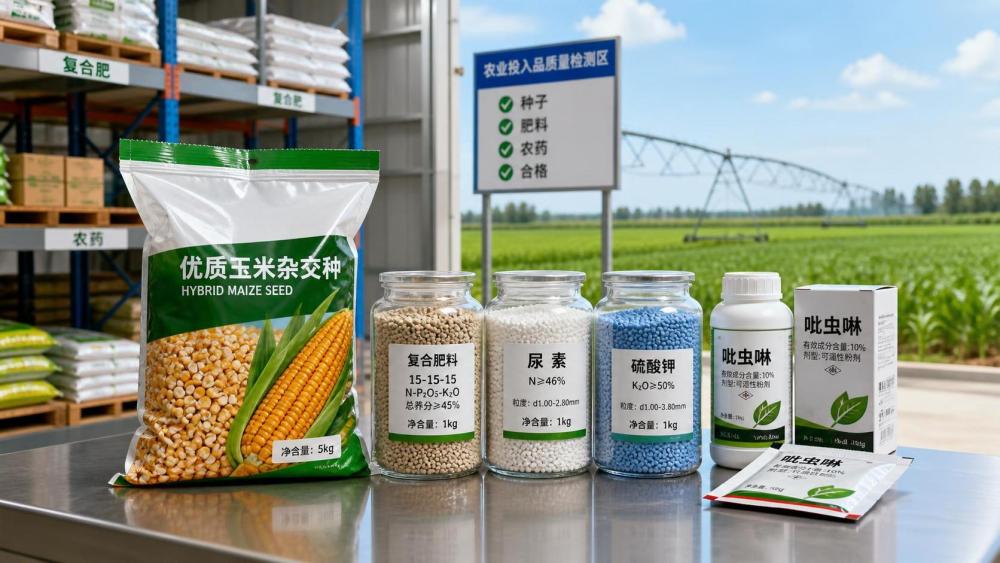
Organic certification creates a frequent point of confusion. Certification of an input as acceptable for use in an organic production system is different from certification of an organic crop. The first concerns whether the formulation, ingredients, processing aids, and manufacturing controls meet the applicable input standard. It does not prove nutrient suitability for a particular soil, eliminate the need for local authorization, or confirm that a product is free from all potential contaminants. The exact permitted use should be reviewed: some materials are allowed with restrictions on crop stage, application rate, source material, or recordkeeping.
Crop protection products: registration and label conditions govern use
Herbicides, insecticides, fungicides, plant growth regulators, adjuvants, repellents, and fumigants require a more restrictive review because the legal authorization is normally tied to product identity and label instructions. The relevant registration should match the formulation, concentration, manufacturer or authorization holder, and destination market. Similar trade names, shared active ingredients, or parallel packaging should not be treated as proof of equivalence.
The active ingredient alone is insufficient. Formulation type affects handling, compatibility, application rate, storage stability, and exposure profile. A suspension concentrate, emulsifiable concentrate, soluble powder, and granule can have different approved uses even when they contain the same active substance. Tank-mix advice supplied in marketing material should not override label restrictions, local rules, crop limits, pre-harvest intervals, re-entry conditions, or pollinator protections.
Certificates of analysis for crop protection products deserve close scrutiny. They should be linked to the actual manufacturing batch and state the tested parameters, such as active ingredient content, relevant impurities, physical properties, and appearance where applicable. A certificate copied from a typical specification is not equivalent to a batch result. Discrepancies between batch number formats on drums, safety documentation, and analytical certificates should be resolved before release into storage.
Biological crop protection products and microbial inoculants require a different interpretation of analytical evidence. Viable count, strain identity, purity, shelf life, carrier material, and storage temperature can be more informative than a broad claim such as “microbial fertilizer” or “biofungicide.” A product can pass a test at manufacture and lose activity after heat exposure, freezing, or prolonged warehouse storage. Confirm whether the stated viable count applies at manufacture, at packing, or through the expiry date.
Traceability is the link between certification and the delivered lot
Many approval failures occur after the certificate has been accepted. The delivered product may come from a different site, be repacked by another entity, or arrive under a lot number not shown in the submitted documents. Traceability review should establish an unbroken link from manufacturer to receiving location. That link normally includes the supplier identity, manufacturing site, product name, lot or batch number, production or packing date, quantity, transport record, and receiving inspection record.
Repacking needs particular care. A certified bulk product can lose practical traceability when transferred into smaller containers unless the repacker preserves lot identity, relabels accurately, controls cross-contamination, and documents the reconciliation between incoming and outgoing quantities. This concern is particularly relevant for treated seed, biological materials, powdered amendments, and products with multiple grades that use similar packaging.
Retention samples are useful when the input has a long application window or when a product will support audited crop programs. The sample should be drawn from the received lot, sealed, labeled, and stored under conditions that do not materially alter the material. Keeping an open container of moisture-sensitive fertilizer or a temperature-sensitive biological product does not provide reliable later evidence.
Evaluate laboratories and inspection bodies with the same discipline
Analytical reports are strongest when issued by a competent laboratory operating within a recognized scope for the method used. The report should identify the sample, method, result units, reporting basis, date, and any qualifiers. A method suited to total nutrient analysis may not be suited to estimating plant-available nutrient fractions. Similarly, a broad heavy-metal screen may not address the specific contaminant of concern in a recycled-input stream.
Sampling is often the limiting factor. Testing a single scoop from a large bulk delivery may produce a precise result that does not represent the shipment. Granular blends, mixed organic amendments, and sediment-prone liquids require a sampling plan that accounts for segregation or settling. The record should state who sampled, when, from which containers or vehicle compartments, and how the composite sample was prepared.
Inspection certificates also need scope review. A certificate confirming an annual site audit does not necessarily cover outsourced blending, contract manufacturing, temporary storage, or a newly added production line. Where the input is produced through several facilities, confirm which steps are included: raw-material sourcing, formulation, blending, packaging, testing, warehousing, and dispatch.
Document conflicts that should stop approval
Some discrepancies are administrative and can be corrected without affecting product identity. Others indicate that the evidence may belong to a different product or lot. A mismatched batch number, expired certificate, missing legal entity, unlisted manufacturing site, altered certificate layout, unexplained formulation change, or laboratory report without sample identification should trigger a hold rather than a conditional approval.
Certificate validity dates require context. A valid facility certificate cannot compensate for an expired product registration. Conversely, a product registration may remain valid while the supplier's certification for a particular production scheme has lapsed. Review each document against the claim it is supposed to support and record the result separately.
A controlled approval record should preserve the approved product name, version of label or specification, certificate references, approved source site, expiry dates, and conditions of use. Any change in formulation, source facility, packaging format, certification scope, or destination market should reopen the review. This prevents an earlier approval from being applied automatically to a materially different input.
Certified agricultural inputs are best treated as verified configurations: a specific product, from a defined source, in a traceable lot, supported by evidence that fits the intended use. That level of precision turns certification from a filing exercise into a defensible control over field and food-chain risk.
Related News
- How Can Businesses Source Sustainable Agriculture Inputs with Verified Certifications?Sep 11, 2026How to source sustainable agriculture inputs with verified certifications: learn practical checks for supplier claims, traceability, compliance, and resilient procurement.
- Which Certifications Should Buyers Check When Sourcing Agricultural Inputs?Sep 09, 2026Certified agricultural inputs: learn which certificates, registrations, lot tests, and traceability records buyers should verify to reduce sourcing risk.
- Layers Poultry Farming in Nigeria: Budgeting Housing, Cages, and FeedAug 28, 2026Layers poultry farming in Nigeria starts with smarter budgeting. Learn how housing, cages, and feed decisions affect costs, flock performance, and long-term profit.
- How to Build a Livestock Management Strategy for Southeast Asia’s Climate and Cost PressuresAug 09, 2026Livestock management Southeast Asia: learn how to cut heat stress, feed waste, transport losses, and disease costs with a climate-smart, profit-focused strategy.