




Search
Related News
- 00
0000-00
Can an Agricultural Trade Insights dashboard flag supply risks early? - 00
0000-00
Is Precision Nutrition North America right for a personalized diet plan? - 00
0000-00
How to build a technology evaluation framework for farm automation - 00
0000-00
How agri-tech forecasting data can improve planting decisions - 00
0000-00
What the Global Nutrition Trends dashboard reveals about supplement demand
Can Agricultural Machinery Be Retrofitted for Precision Farming?




Yes, much agricultural machinery can be retrofitted for precision farming, and for many operations it is a more rational first step than replacing otherwise serviceable tractors, sprayers, spreaders, planters, or combines. The answer depends less on the age printed on the machine's serial plate than on three practical questions: whether the machine can be controlled accurately, whether it has a reliable way to receive or record data, and whether the expected savings or yield response justify the cost and complexity.
A retrofit will not turn every older machine into a fully integrated digital platform. It can, however, add meaningful capabilities such as guidance, section control, application-rate control, yield mapping, and field documentation. For a grower trying to reduce overlap, manage variable soils, or document input use, those functions may deliver most of the operational value associated with precision farming.
Start With the Farming Decision, Not the Hardware
The most useful retrofit is tied to a specific decision that is currently difficult, slow, or wasteful. A GPS display installed simply because it is available may see limited use. A guidance system fitted to reduce overlaps in spraying or fertiliser spreading addresses a visible cost. A rate controller connected to prescription maps serves a different purpose: placing seed, nutrients, or crop-protection products according to defined management zones.
Before choosing equipment, it helps to identify where precision is being lost. Common starting points include:
- Repeated overlap or missed strips during spraying, spreading, drilling, or cultivation.
- Uneven application caused by manual adjustments, inconsistent speed, or field shape.
- High input costs in fields with substantial soil, yield, or crop-condition variation.
- Limited records of where products were applied, at what rate, and under which field conditions.
- Difficulty operating efficiently in low visibility, at night, or across irregular field boundaries.
For many farms, guidance and automatic section shutoff are the easiest entry point because the benefit is understandable and the mechanical integration is relatively modest. Variable-rate application can be more valuable where field variability is well established, but it requires better data, a controllable implement, and a credible agronomic plan. Installing variable-rate hardware without reliable prescription logic can create an expensive way to apply inconsistent decisions.
What Existing Machines Can Usually Be Retrofitted?
Compatibility varies by make, model, hydraulic system, electrical architecture, and implement design. Still, a wide range of machines can support at least some precision functions. Older equipment is often suitable when its core mechanical condition is sound and the retrofit does not depend on proprietary electronic controls that the machine lacks.
Tractors
Tractors are frequent retrofit candidates because they provide the platform for many field operations. Assisted steering systems can range from electric steering units mounted at the wheel to hydraulic autosteer systems integrated into the steering circuit. The appropriate option depends on the tractor's steering response, hydraulic condition, expected accuracy, and how often it will be used.
Retrofit guidance can support pass-to-pass consistency for tillage, seeding, spreading, and spraying. A basic visual guidance display may be adequate for wide implements and lower-risk operations. Planting, strip-tillage, controlled traffic, or operations near existing crop rows may require a more accurate correction signal and more reliable automated steering.
Planters and Seed Drills
Planters and drills can often accept monitoring systems, section control, row shutoff, downforce sensing, and population or seeding-rate control. The practical limit is usually the existing metering system. A mechanically driven machine may need additional drives, sensors, or clutches before it can vary rates or stop individual rows. Pneumatic or electrically driven systems can be more adaptable, though installation and calibration still matter.
Seed placement deserves particular caution. Guidance can make passes straighter, but it does not correct worn opener discs, poor depth control, inconsistent seed tubes, incorrect closing-wheel pressure, or a badly maintained meter. Retrofitting electronics onto a planter with unresolved mechanical variation can make the data look more sophisticated while leaving emergence problems untouched.
Sprayers and Spreaders
These machines are often strong candidates for retrofitting because input overlap is easier to identify and rate control can be tied directly to product use. A sprayer may be upgraded with GPS guidance, boom section control, nozzle-level control, speed-linked rate control, flow monitoring, or pressure sensing. Fertiliser spreaders may be fitted with rate controllers, weighing systems, boundary management functions, and GPS-driven section control where the delivery system allows it.
The starting condition matters. No controller can compensate fully for damaged nozzles, inconsistent boom height, pump wear, blocked lines, poor agitation, or an uneven spreading pattern. Mechanical inspection and calibration should happen before the digital layer is specified.
Combines and Forage Harvesters
Yield monitoring and mapping can sometimes be added to harvesting equipment, although the reliability of the resulting map depends heavily on sensor placement, calibration, crop type, moisture measurement, and time alignment with GPS position. Harvest data are valuable when treated as one layer of evidence, not as an unquestionable prescription for the next season.
Forage operations may also benefit from guidance, field coverage records, and machine data collection. In both cases, the decision should be linked to the intended use of the information. There is little value in capturing large datasets that no one has the time or agronomic basis to interpret.
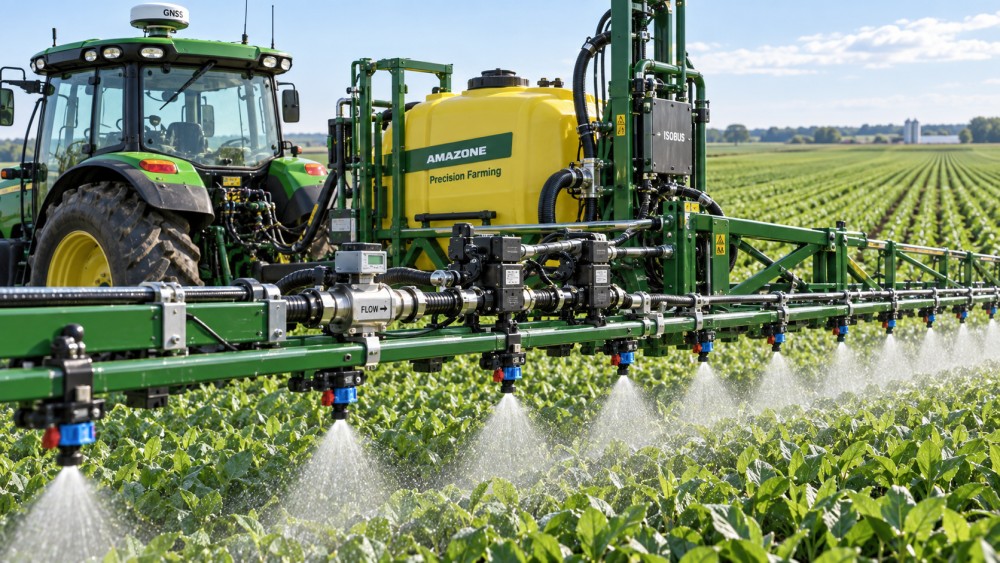
The Retrofit Stack Must Match the Machine
Precision retrofits are commonly described as a list of components: receiver, display, controller, sensors, modem, software, and subscriptions. That view can obscure the fact that the components must work as a system. A functional retrofit normally has four layers.
A machine may need only the first layer to deliver useful results. For example, a tractor with a lightbar and accurate GNSS can reduce operator fatigue and improve pass consistency. Adding section control requires the implement to have independently controllable sections and a compatible control path. Adding variable-rate capability requires a dependable link between prescription, controller, machine speed, and actual output.
Interoperability deserves attention early. Agricultural electronics use multiple connector types, communication standards, file formats, and software ecosystems. Even where an implement supports an industry-standard interface, the available functions may not be identical across displays and controllers. Buyers should ask for a clear, machine-specific description of what will work: guidance only, rate monitoring, section switching, documentation, prescription import, as-applied map export, or all of these.
Accuracy Is an Operational Requirement, Not a Marketing Label
Satellite positioning accuracy is often discussed as though higher accuracy is automatically better. In practice, the appropriate level depends on the operation. Broad spreading or tillage may tolerate modest pass-to-pass deviation. Precision planting, repeatable controlled traffic lanes, mechanical weeding, and operations close to crop rows demand tighter repeatability.
It is useful to separate three issues that are often blended together: how accurately a position is shown at a moment in time, how consistently adjacent passes line up, and whether a line can be repeated days or seasons later. A system that looks accurate during one pass may not provide the repeatability needed for a later operation. Terrain, tree cover, signal interruptions, antenna placement, machine slippage, implement drift, and steering calibration also affect field performance.
Implement position can be as important as tractor position. A drawn sprayer, drill, or cultivator may move sideways on slopes or pull differently in changing soils. Autosteer keeps the tractor on its intended line; it does not automatically guarantee that every trailing implement stays exactly where the tractor has been. Farms working on uneven land should consider this before treating a guidance specification as a complete precision solution.
Where Retrofits Commonly Fall Short
The claim that an older fleet can simply be digitised has limits. Some machines do not have the electrical capacity, hydraulic responsiveness, physical mounting space, or controllable metering system required for advanced upgrades. Others can technically accept the equipment but become difficult to support because of worn components, undocumented wiring, incompatible valves, or missing parts.
There is also a point at which layered upgrades become harder to justify than replacement. This can occur when a machine needs major mechanical repairs at the same time as extensive electronics, drives, sensors, plumbing, and control integration. The decision should compare the full retrofit cost, including installation, calibration, cabling, subscriptions, operator training, seasonal support, and downtime risk, against the value of a newer platform with native controls and warranty coverage.
Data friction is another frequent disappointment. A farm may collect boundary files, application records, yield maps, soil results, and imagery, yet still lack a repeatable process for using them. Precision farming produces value through better field decisions, not through file accumulation. The person responsible for agronomy and the person responsible for machinery should agree on who creates prescriptions, who checks calibrations, where data are stored, and how results will be reviewed after harvest.
A Practical Assessment Before Committing Capital
A disciplined assessment can prevent a retrofit from becoming a collection of isolated devices. Begin with the operation that has the clearest financial or management consequence. Then inspect the machine as a machine before evaluating it as a data platform.
- Confirm the implement's mechanical condition, output consistency, and calibration history.
- Identify the desired function in operational terms, such as automatic boom shutoff or documented variable-rate fertiliser application.
- Check whether the machine can physically and electronically support the required controller, sensors, actuators, and power supply.
- Define the positioning accuracy and repeatability needed for that operation.
- Verify compatibility across the tractor, implement, display, receiver, controller, and farm data system.
- Calculate the likely benefit from reduced overlap, lower input use, improved timeliness, labour efficiency, or better management decisions.
- Plan installation before peak fieldwork and allow time for calibration, operator familiarisation, and troubleshooting.
The best first retrofit is often one that is used on many acres and has a simple operating discipline. A guidance system that runs through every planting, spraying, and spreading pass can be easier to justify than a highly specialised sensor package used only occasionally. Once the farm has reliable records and operators are comfortable with the workflow, more advanced control can be added where it has a defined purpose.
Retrofit in Stages, but Design the End State
Precision farming does not require an all-at-once conversion. A staged approach can reduce financial exposure and allow each upgrade to prove its usefulness. Guidance may come first, followed by section control, then rate control and more structured data use. The stages should still be planned around an eventual system architecture. Buying a low-cost display that cannot communicate with later controllers or export usable records can create avoidable replacement costs.
For operators asking, “can agricultural machinery be retrofitted for precision farming?”, the practical answer is that retrofitting is often feasible and frequently worthwhile, provided the upgrade solves a real field problem. Start with the machine's mechanical readiness, select the accuracy and automation level the operation actually needs, and treat data management as part of the implementation rather than an optional extra. Precision begins with a repeatable decision and a machine capable of carrying it out consistently.
Related News
- How agri-tech forecasting data can improve planting decisionsSep 23, 2026Agri-Tech Forecasting data helps growers optimize planting windows, crop choices, inputs, and risk. Discover actionable insights for smarter, more resilient farm decisions.
- Can Agricultural Machinery Be Retrofitted for Precision Farming?Sep 26, 2026Can agricultural machinery be retrofitted for precision farming? Explore compatible upgrades, costs, GPS guidance, rate control, and practical steps to boost efficiency.
- Is Plant Propagation Technology Ready for Commercial-Scale Production?Sep 05, 2026Is plant propagation technology mature enough for commercial scale? Explore proven automation, AI, tissue culture, and the key factors driving nursery ROI.
- What Precision Farming Technology Delivers the Best ROI for Mid-Size Farms?Aug 08, 2026Precision Farming technology ROI for mid-size farms starts with the right fit. Discover which tools—auto-steer, section control, or variable rate—deliver faster payback.