




Search
Related News
- 00
0000-00
How nutritional security assessment identifies gaps in local diets - 00
0000-00
How to assess a food packaging technology manufacturer’s line integration capability - 00
0000-00
Which industrial equipment cost factors matter most before approval? - 00
0000-00
What determines the price of an automated feeding system? - 00
0000-00
How to qualify a specialty chemicals manufacturer for food-contact formulations
How Long Do Biodegradable Seedling Trays Last in Soil?




Biodegradable seedling trays rarely have one fixed lifespan in soil. A tray made from molded fiber may soften and lose its original form within a growing season, while a denser tray containing wood fiber, peat, rice hulls, or a plant-based binder can remain partly recognizable for much longer. The useful question is not simply whether the tray disappears. It is whether it stays intact through propagation, allows roots to exit after planting, and breaks down without restricting the young plant.
For the query how long does seedling tray biodegradable material last in soil, the practical answer is: long enough to establish the transplant under suitable conditions, but not necessarily long enough to vanish quickly. Warm, moist, biologically active soil speeds decomposition. Cool, dry, compacted, or low-organic-matter soil slows it sharply. Material thickness and the way the tray was formed often matter as much as the material named on the label.
Separate nursery durability from soil breakdown
A biodegradable tray has two different service periods. The first is its usable life above ground. During filling, watering, handling, transport, and transplanting, cells need enough strength to hold growing media and roots. The second period begins once the tray or cell is placed in soil. At that point, moisture enters the fiber structure, soil organisms begin using organic components, and roots seek routes through or around the wall.
These periods should not be confused. A tray that becomes soft rapidly in a humid greenhouse may fail before transplanting. A tray that remains firm in the nursery can still decompose appropriately after planting because soil contact, microbial activity, and repeated wet-dry cycles change the conditions. Conversely, a product described as biodegradable can persist as a stiff collar around the root zone when it is buried in cold or dry ground.
Visible disappearance is also a poor measure of success. Fibrous walls may remain visible after they have become permeable enough for roots and water to move through. A tray may lose structural integrity yet leave coarse particles in the planting hole. That is often normal. The concern is a continuous, strong barrier that redirects roots, holds the plug above the surrounding soil, or creates a dry gap around the root ball.
Material type sets the starting point
Most biodegradable propagation trays use compressed organic fibers, though their formulations differ. Molded paper pulp and recycled fiber trays tend to absorb water readily. They can soften quickly when left wet, especially at thin cell edges and drainage openings. Wood-fiber trays may be more rigid at first but vary considerably according to fiber length, binder content, wall thickness, and pressing pressure. Peat-based pots and fiber blends often hold moisture well and can integrate into soil, yet dense or dry walls may initially resist root passage.
Some trays include starches, lignin-rich fibers, natural latex, or other binders to improve wet strength. A binder is not automatically a problem, but it changes the timeline. It may be necessary for trays that must survive extended propagation or mechanical handling. The trade-off is that a high-strength formulation can remain intact longer after transplanting than a lightly bonded one. Product descriptions that only state “compostable” or “biodegradable” do not reveal this difference.
Thickness deserves close attention because it is often overlooked. A shallow, thin-walled plug cell has little material to break down and exposes more surface area to soil. A thick-walled pot or tray edge may persist well past establishment, even when made from the same basic fiber. The bottom and sidewall do not always behave alike: drainage holes admit water and roots early, while upper rims can stay dry and intact.
Soil conditions control the actual timeline
Microorganisms, oxygen, moisture, and temperature drive biological decomposition. Moist soil provides the water needed for fibers to soften and for microbial activity to proceed. Warm soil generally accelerates the process. A tray planted into cool spring ground may hold its form for a prolonged period, then deteriorate rapidly once temperatures rise and irrigation becomes regular.
Dry soil causes a different result. The tray wall may remain hard enough to resist root penetration while the growing medium inside dries at a different rate from the surrounding ground. This is especially likely when a cell wall extends above the soil surface. The exposed rim can wick water away from the plug and remain less biologically active than the buried portion. Planting the entire biodegradable container at the correct depth matters because exposed material does not break down like material in close soil contact.
Compaction and poor contact around the tray can delay decomposition and establishment at the same time. Air gaps prevent moisture from moving evenly between the native soil and the plug. Roots then meet a dry, firm wall instead of a softened fiber layer. Pressing soil gently but firmly around the transplant removes major voids without compressing the root zone excessively.
Soil biology varies by location and management. A living soil with regular organic inputs and adequate moisture has more activity capable of processing plant fibers than sterile or highly disturbed media. This does not mean that adding compost directly against every tray wall is required. It means the claimed degradation behavior should be judged in the soil where the tray will actually be used, not only in a controlled product demonstration.
Root penetration is a better field test than appearance
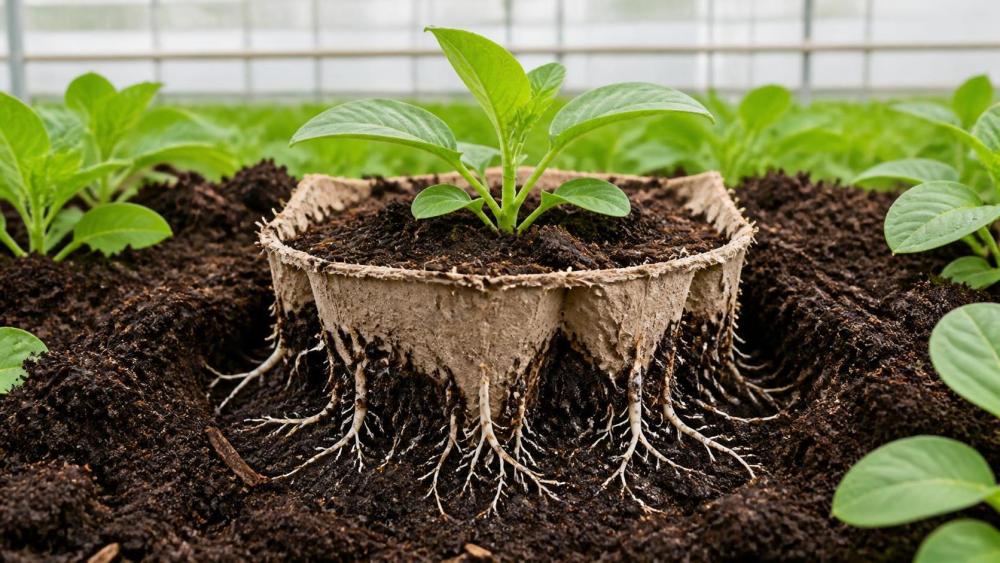
After transplanting, inspect a small number of plants rather than waiting for the tray to disappear. Carefully uncover one planting hole after a period of active growth. Roots emerging through the sidewall and bottom indicate that the material is no longer functioning as a serious barrier. White roots clustered only inside the original cell, or roots circling along the inner wall, suggest that the tray remained too intact or that the plug dried before roots could escape.
Do not diagnose every weak transplant as a tray failure. Poor root emergence can also result from an underdeveloped root system, cold soil, salt accumulation in the plug, transplant shock, inadequate irrigation, or a planting hole that was not fully opened. The useful comparison is between the wall condition and the root pattern. A soft wall with few outward roots points toward a plant or soil issue. A dense, dry wall with roots pressed against it points toward a container-to-soil transition problem.
There is also a difference between roots passing through fibers and roots finding seams. Some molded trays have thinner areas at corners, perforations, or drainage channels. Early root escape through those points can be enough for vigorous plants, but slow-rooting crops may need more uniform wall softening. A tray that works well for a fast-growing annual is not automatically suitable for a crop that remains in the cell longer or establishes more slowly after field planting.
Handling decisions that change breakdown behavior
Storage begins affecting performance before a tray is filled. Fiber trays kept in a humid area can absorb atmospheric moisture, soften at contact points, and deform under stacked weight. Excessively dry storage has a different drawback: very dry fibers may pull water rapidly from moist growing media during the first irrigations. Keep unopened trays protected from rain and direct floor moisture, and avoid stacking them where lower layers bear prolonged compression.
During propagation, irrigation style changes durability. Frequent overhead watering saturates exposed rims and tray edges. Capillary or ebb-and-flow systems place moisture mainly at the base, which may preserve upper structure while keeping root media hydrated. Neither approach is universally better; the tray formulation and crop cycle determine whether prolonged wetness is desirable. When cell walls begin collapsing before roots hold the plug together, reducing unnecessary surface saturation is often more effective than changing the entire propagation system.
At transplanting, tearing away every biodegradable tray is not always needed, but leaving a stiff, dry rim above soil level is a common source of problems. If the material is thin and thoroughly wet, planting it intact may preserve roots and reduce handling damage. If sidewalls are dense, roots are circling, or the tray has a reinforced base, opening or scoring the wall can create a route for roots and water. Remove only material that is clearly restricting the root ball; aggressive stripping can pull apart a plug and set the plant back.
- Water the tray before transplanting so the fiber is pliable and the root plug stays together.
- Set the plug so no absorbent rim stands above the finished soil grade.
- Where the container wall feels rigid, make a few shallow vertical tears rather than crushing the root ball.
- Apply enough water after planting to settle soil against the tray and eliminate dry gaps.
Why labels can create false expectations
“Biodegradable” describes an end-of-life capability, not a promise that every tray will vanish within one crop cycle in every soil. Some materials are designed to break down in managed composting conditions that provide sustained heat, moisture, aeration, and microbial activity. Garden or field soil may not provide those conditions, particularly during a dry season or in a cool climate. A product can still be appropriate for direct planting when it allows roots to establish before complete decomposition.
Compostability and soil degradability should therefore be treated as related but separate performance questions. A tray may be suitable for composting after use but not intended to be planted intact. Another may be engineered for root penetration in soil while leaving fragments that decompose later. Before selecting a format, clarify whether the intended workflow is to transplant the full cell, remove the plug, or compost the empty tray after extraction.
Published test conditions are useful only when read alongside the production cycle. Ask about wall thickness, expected greenhouse duration, compatible irrigation conditions, and whether the tray is meant to be buried. A statement about the material alone cannot answer whether a particular cell design will withstand weeks of nursery use and then soften in a particular planting bed.
Match tray life to the crop schedule
The best tray is not the one that breaks down fastest. It is the one whose strength declines at the right time. Short-cycle seedlings may need only modest wet strength and can benefit from a thin wall that integrates quickly after transplanting. Larger transplants, extended propagation periods, or repeated movement between benches and planting areas require greater structural reserve. Selecting a fragile tray for a long cycle can create tearing, distorted cells, and lost plugs before planting. Selecting an overly durable tray for direct planting can produce restricted roots after planting.
Trial a small batch through the complete sequence: storage, filling, irrigation, lifting, transport, transplanting, and early establishment. Record when walls soften, whether cells separate cleanly, how often plugs are damaged, and whether roots cross the material after planting. Use the same soil moisture and planting depth expected in routine work. This reveals more than a quick soak test, which measures water absorption but says little about root behavior or microbial breakdown.
When a biodegradable tray lasts longer than expected in soil, first examine moisture, planting depth, wall density, and root escape rather than assuming the product has failed. When it collapses too early, review propagation duration, irrigation exposure, storage humidity, and the mechanical stress imposed during handling. The right outcome is a stable plug before transplanting and an unobstructed root zone afterward, even when pieces of the original tray remain visible for a while.
Related News
- How Long Do Biodegradable Seedling Trays Last in Soil?Sep 08, 2026How long does seedling tray biodegradable material last in soil? Discover factors affecting breakdown, root growth, and the best trays for successful transplanting.
- How to Choose Organic Growing Media for Better Root HealthJul 26, 2026Organic growing media selection starts with root health. Learn how to compare water retention, aeration, pH, EC, and batch consistency for stronger crops and smarter growing decisions.
- EU Sets 75% Recycled PET Threshold for CE-Labeled PackagingJul 12, 2026EU Sets 75% Recycled PET Threshold for CE-Labeled Packaging: learn how the 2026 EU rule affects claims, certification, traceability, and exporter compliance.
- Indonesia BPOM Waives Import Testing for Eco-PackagingJul 11, 2026Indonesia BPOM waives import testing for eco-packaging that meets ISO 17088:2023. Learn how this zero-inspection rule can speed clearance, cut compliance delays, and reshape sourcing decisions.