




Search
Related News
- 00
0000-00
How to build a technology evaluation framework for farm automation - 00
0000-00
How agri-tech forecasting data can improve planting decisions - 00
0000-00
What the Global Nutrition Trends dashboard reveals about supplement demand - 00
0000-00
When pilot production is needed before scaling a food process - 00
0000-00
What to verify before selecting a food engineering manufacturer
What Maintenance Does Drip Irrigation Need in Arid Climates?




What Maintenance Does Drip Irrigation Need in Arid Climates?
What maintenance schedule does drip irrigation need in arid climates? The practical answer is more demanding than many irrigation plans assume. Drip systems are highly efficient when water reaches each plant at a consistent flow and pressure, but dry environments create conditions that steadily work against that consistency: dusty water sources, mineral-rich groundwater, algae in storage ponds, intense heat, windblown debris, and salt accumulating where irrigation water meets dry soil.
For farms, nurseries, landscaping operations, and controlled-environment projects, maintenance is not merely a repair task. It is part of water management, crop-risk control, and operating-cost discipline. A blocked emitter may look insignificant, yet a row of partially clogged lines can create uneven crop development long before the issue becomes visible from the field edge. In arid production areas, where there is little rainfall to compensate for poor irrigation distribution, small maintenance failures are often amplified.
A sound program combines routine inspection, filtration management, line flushing, pressure verification, water-quality review, and end-of-season protection. The correct frequency depends on water source, system design, crop value, irrigation duration, and local climate. There is no universal calendar that fits every site. Still, there are clear maintenance priorities that operators can use to build a reliable schedule.
Why arid conditions make routine care less forgiving
Drip irrigation is designed to apply water slowly and close to the root zone. That advantage also means its passages are small and sensitive. Suspended sand, organic matter, iron deposits, biological growth, fertilizer precipitates, and mineral scale can restrict filters, valves, emitters, and narrow labyrinth channels. The risk is not limited to poor-quality water. A clean well source may still carry dissolved minerals that form deposits under certain chemical conditions, while surface water may introduce algae or fine sediment after a weather event.
Heat adds another layer of stress. Exposed polyethylene components expand and contract, fittings may loosen, and UV exposure gradually ages materials not intended for long-term surface use. In sandy or desert-edge areas, wind can cover emitters, scour exposed tubing, or push debris into open line ends during maintenance. Rodent damage, field traffic, and cultivation equipment are also more consequential where every irrigation cycle matters.
Salt deserves particular attention. Irrigation water naturally leaves dissolved salts behind as plants use water and evaporation draws moisture upward. Drip irrigation can manage salinity effectively when designed and operated well, but it does not eliminate the issue. Poor distribution, inadequate leaching where appropriate, or a neglected blocked zone can leave salts concentrated around active roots. Maintenance and agronomy therefore need to be reviewed together rather than treated as separate jobs.
Build the schedule around risk, not a generic checklist
The phrase what maintenance schedule does drip irrigation need in arid climates is best approached as a risk question. An orchard supplied by filtered groundwater will not need the same level of attention as a vegetable block using reservoir water, fertigation, and thin-wall seasonal drip tape. The first step is to identify what can enter the system, what can form inside it, and what can damage it from outside.
These intervals are starting points, not prescriptions. If filters show rapid differential pressure change, if water visibly carries sediment, or if an irrigation zone has a history of emitter blockage, the service interval should be shortened. Conversely, a stable, well-filtered source with good operating records may justify a less intensive routine. The key is to adjust from evidence rather than maintaining equipment only because a calendar says it is time.
Filtration is the maintenance center of gravity
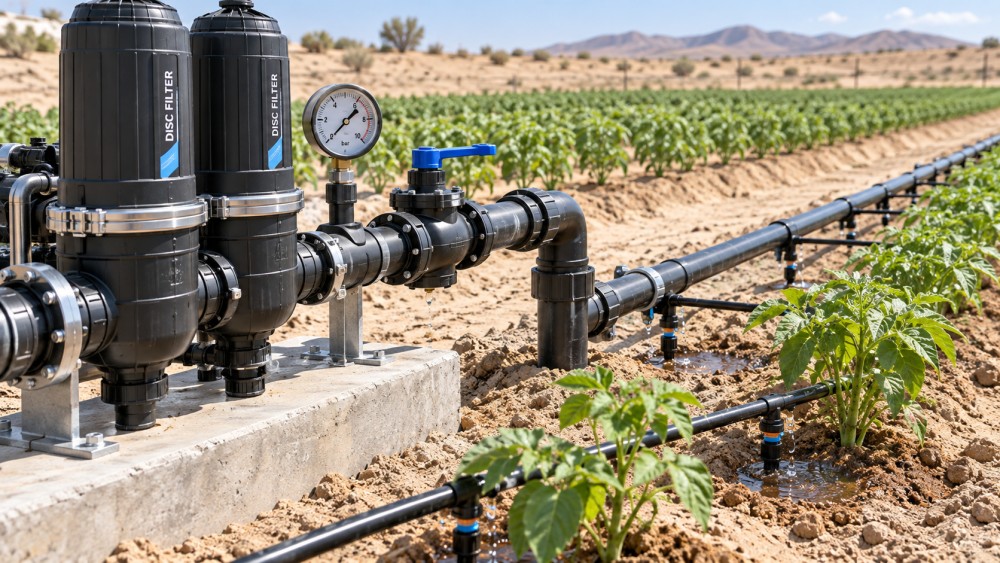
Many field problems begin upstream. Filters are sometimes treated as a passive installation item, but they are the system’s main defense against emitter clogging. Screen, disc, media, and hydrocyclone arrangements each address different particle loads and water conditions. The appropriate configuration should be based on source-water characteristics and the manufacturer’s requirements for the emitters being used.
Operators should record inlet and outlet pressure where the system allows it. A rising difference across a filter generally signals that cleaning is needed, although the exact operating limit should follow the filter and system supplier’s guidance. Waiting until visibly poor irrigation occurs is too late. Filter cleaning should be methodical: inspect screens or discs for tears and deformation, make sure seals are seated correctly, and look for bypass routes that can allow unfiltered water through.
Automatic backflush systems reduce labor but do not remove the need for oversight. A malfunctioning valve, insufficient backflush pressure, blocked drain line, or controller fault can leave an apparently automated system unprotected. During peak irrigation months, a quick confirmation that the backflush sequence is actually completing can prevent a much larger troubleshooting exercise downstream.
Flushing lines is not the same as solving clogging
Flushing removes loose sediment and accumulated material from mains, submains, manifolds, and laterals. It should be performed with sufficient flow to carry debris out, following the design and operational guidance for the particular system. Opening line ends without enough flushing energy may create the appearance of maintenance while leaving deposits in place.
A useful field observation is the condition of discharge water at the line ends. If it begins dirty and clears, the event has revealed accumulated material. If it remains discolored or particulate-laden, the operator may need to review source-water treatment, filtration, flushing duration, or the possibility of deposits already adhering inside the lines. Keeping a simple record of which blocks required repeated flushing helps identify chronic areas rather than treating every occurrence as random.
Chemical treatment may be considered when blockage is linked to biological growth, carbonate scale, iron, or fertilizer incompatibility, but it should not be improvised. The correct approach depends on water analysis, deposit type, irrigation materials, crop considerations, worker safety procedures, and local rules governing handling and discharge. Chemical injection without diagnosis can damage equipment, create unwanted reactions, or fail to address the actual cause. When recurring clogging appears, testing the water and examining affected emitters usually provide a better basis for action than repeated blind treatments.
Pressure and flow reveal problems that visual inspection misses
Uniformity depends on pressure remaining within the design range for the emitters and pressure-compensating devices, if installed. Low pressure may point to a pump issue, blocked filter, leaking mainline, valve problem, or excessive demand. Unusually high pressure can increase the chance of fitting separation and leaks, particularly in systems exposed to heat and physical disturbance.
A practical routine is to compare readings at the headworks and at representative points near the ends of selected zones. The comparison is more informative when recorded under similar operating conditions. A sudden shift from the usual pattern deserves investigation even if plants still appear healthy. By the time visible stress develops, the crop may already have experienced uneven water delivery for several cycles.
Field walks remain valuable. Look for wet patches, dry strips, unusually vigorous plants near a leak, collapsed tubing, exposed connections, damaged risers, and emitters buried by shifting soil. In arid climates, a leak may not create a dramatic puddle; water can disappear into dry ground quickly. Changes in plant appearance, soil wetting pattern, or irrigation run time can be the first useful clues.
Fertigation requires a separate discipline
Fertigation can place nutrients close to active roots and reduce unnecessary handling, but it also introduces compatibility and residue risks. Fertilizer products should be assessed against the source water and each other before injection. Certain combinations can form precipitates, especially where water chemistry is hard or alkaline. A clean filter does not guarantee that dissolved materials will not deposit later in the network.
After fertigation, the system normally needs a clear-water phase long enough to move nutrients through the irrigation network without leaving concentrated solution in lines, valves, or emitters. The required time depends on hydraulic layout and should be based on the specific installation. Injection equipment, backflow prevention arrangements, calibration, and safety procedures also need regular inspection. These are operational safeguards, not optional accessories.
Manage salts in the root zone, not just inside the equipment
A well-maintained system can still underperform if salt movement is ignored. Under drip irrigation, salts often move toward the outer edge of the wetted zone. This pattern can be manageable, but it changes with soil texture, emitter spacing, irrigation timing, rainfall, crop rooting depth, and water quality. Where saline water or saline soils are a concern, monitoring should include the root zone rather than relying only on the water source at the pump.
Maintenance staff and agronomy teams should share observations. A blocked emitter is a mechanical issue, yet its consequence may be localized salinity stress. Likewise, an attempt to correct a field salinity concern by simply extending irrigation time may waste water if the real issue is poor distribution or pressure imbalance. Soil and water testing, where needed, should be interpreted in the context of crop and local conditions.
Seasonal inspections protect the next irrigation window
Before a high-demand season, inspect pumps, filters, pressure regulators, gauges, valves, injection equipment, control wiring, and visible pipework. Replace unreliable gauges rather than building decisions on doubtful readings. Check spare parts that cause the longest downtime when they fail, such as repair couplings, filter elements, valve seals, and compatible connectors. The exact inventory depends on the installed system, but waiting for a small fitting in a remote production period can be costly.
At shutdown, flush the network, repair leaks, secure line ends, clean filters, and protect components according to the local climate and manufacturer guidance. In areas with occasional cold events, freeze protection may still matter even when the broader climate is arid. For seasonal drip tape, removal and disposal should be planned in line with local waste-management requirements rather than left as an afterthought.
Turn maintenance records into operating intelligence
The most useful records are simple enough to maintain: irrigation block, date, pressure observations, filter cleaning, flushing events, leaks repaired, water-quality concerns, fertilizer products injected, and recurring emitter issues. Over time, these records show whether a problem follows a particular source, field zone, season, or operating practice. They also make handovers between managers, technicians, and growers much less dependent on memory.
This is where irrigation maintenance connects to wider agri-food decision making. The Global Agri-Food & Life Matrix (GALM) examines agriculture as part of a full lifecycle extending from production systems to food quality and human wellbeing. Through its Strategic Intelligence Center, GALM brings together economic, engineering, and consumer perspectives to examine the conditions shaping sustainable agriculture. For decision makers, dependable irrigation records are not merely maintenance paperwork; they are operational evidence that can support water-risk assessment, technology choices, and more grounded investment planning.
In arid climates, drip irrigation rewards attention to detail. Start with the water source, protect the system through effective filtration, verify pressure rather than guessing, flush with purpose, and investigate recurring clogging before it affects the crop. A maintenance schedule should evolve with field evidence. That disciplined approach helps preserve both the equipment and the scarce water it is meant to distribute.
Related News
- What Maintenance Does Drip Irrigation Need in Arid Climates?Sep 24, 2026What maintenance schedule does drip irrigation need in arid climates? Discover practical checks for filters, flushing, pressure, salts, and reliable water efficiency.
- Which agricultural technology in Europe can cut irrigation water use?Sep 08, 2026Agricultural technology Europe: discover how soil sensors, precision drip irrigation, automation and AI help farms cut water use while protecting yields.
- How Can Irrigation Systems Meet Local Water-Use Regulations?Sep 04, 2026Learn how to ensure irrigation systems meet local water usage regulations with practical tips on permits, metering, scheduling, runoff control, and compliance records.
- When do remote irrigation systems pay off for small farms?Aug 29, 2026Remote irrigation systems can help small farms cut labor, water, and energy costs while protecting crop quality. Discover the ROI factors that determine payback.