




Search
Related News
- 00
0000-00
What a life sciences market trends report reveals about R&D spending - 00
0000-00
When does food processing require 316 instead of 304 stainless steel? - 00
0000-00
Global Wheat Prices Fall as Black Sea Supply Increases - 00
0000-00
A guide to choosing agri-food solutions for farm-to-fork traceability - 00
0000-00
How farm size affects agricultural innovation adoption in Europe
How Can Irrigation Systems Meet Local Water-Use Regulations?




Water rules rarely feel urgent until a permit renewal is delayed, a water bill spikes, or an inspector asks for records that no one can locate. For growers, landscape managers, food-processing sites, nurseries, and mixed-use rural operations, irrigation is no longer simply a question of getting enough water to crops or plants. It is also a question of timing, measurement, source protection, runoff, reporting, and local accountability.
Knowing how to ensure irrigation systems meet local water usage regulations starts with a practical shift in mindset: compliance should be designed into the system, not added after a problem appears. The right approach protects water resources while giving operators clearer control over costs, crop health, and operational risk.
Begin with the rule that applies to your actual site
“Local water regulations” are not one universal checklist. Requirements can differ across countries, states, provinces, municipalities, irrigation districts, watersheds, and groundwater basins. A farm may be governed by one authority for water withdrawal, another for well construction, and another for nutrient runoff or wastewater reuse. A commercial landscape may face seasonal watering restrictions set by a city, while an agricultural facility nearby operates under an allocation or abstraction licence.
Before changing equipment, identify the rules tied to four basic facts:
- Water source: municipal supply, groundwater well, surface water, stored rainwater, reclaimed water, or a shared irrigation district connection.
- Land use: field crops, greenhouse production, nursery stock, turf, public landscaping, livestock areas, or food-processing grounds.
- Location: the parcel’s local jurisdiction and the wider watershed or aquifer area.
- System scale: total irrigated area, pump capacity, daily withdrawal volume, and whether the system is new, expanded, or modified.
Contact the relevant water authority, agricultural extension office, irrigation district, environmental regulator, or municipal utility to confirm current requirements. Do not rely solely on an old permit, a contractor’s memory, or a neighboring property’s practices. Drought declarations, groundwater stress, conservation plans, and infrastructure changes can alter allowable use from one season to the next.
Ask for written clarification on permits, annual or seasonal volume limits, permitted operating hours, metering obligations, backflow prevention, reporting deadlines, and restrictions on irrigation runoff. If reclaimed or recycled water is involved, request the applicable quality standards and separation requirements as well.
Turn regulations into a site-specific water-use map
Compliance becomes much easier when legal language is translated into a working operational map. This does not need to be complicated, but it should be accurate enough that a manager, technician, or auditor can understand where water enters the site and where it goes.
Map the water source, pumps, filters, mainlines, valves, irrigation zones, storage tanks, drainage routes, and sensitive areas such as wells, waterways, wetlands, neighboring properties, and food-handling zones. Add the location of every water meter and pressure gauge. For larger operations, link zones to crops, planting dates, soil types, or landscape categories.
This exercise often exposes avoidable risks. A single meter may be measuring water used by several unrelated blocks, making it difficult to prove that a restricted zone stayed within its allocation. A runoff path may lead toward a drainage ditch. An old irrigation line may be drawing from a source that is no longer covered by a permit. These are not merely technical details; they are the points where routine operations can fall out of compliance.
Measure before making claims about efficiency
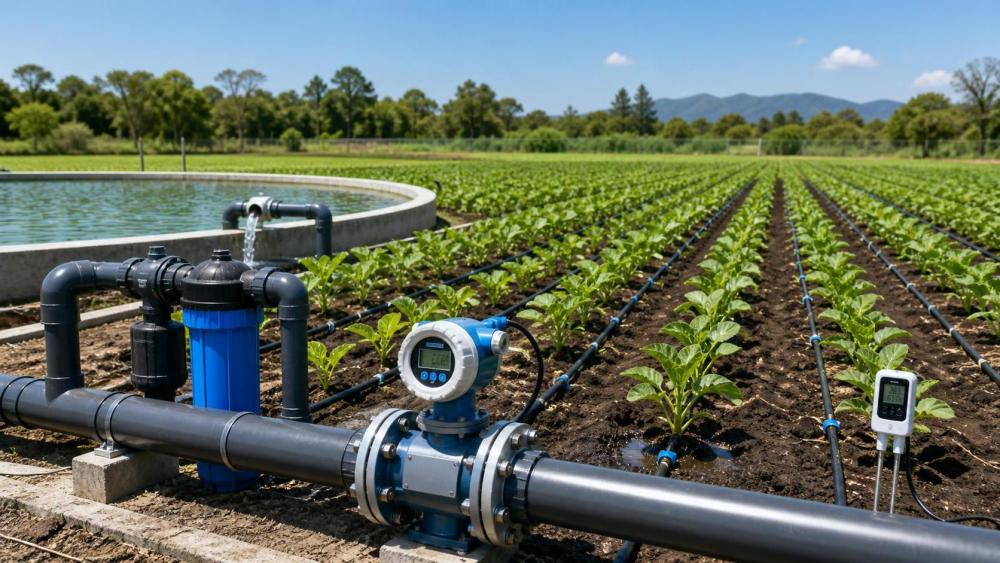
A system cannot demonstrate compliance if no one knows how much water it uses. Flow measurement is the foundation of responsible irrigation management, particularly where permits specify volume caps or where drought rules limit irrigation days and times.
Install and maintain suitable flow meters at the source and, where useful, at major irrigation blocks. Source-level measurement shows total withdrawal. Zone-level measurement reveals where water is being used unusually fast. In a high-value greenhouse or nursery, separate meters can distinguish production water from cooling, sanitation, or staff-use demand.
Meter readings should be recorded at a frequency that matches the regulatory risk. A small site with a simple schedule may need weekly or monthly checks. A farm operating close to an allocation limit may need daily digital readings and alerts. The important point is consistency: records should show a clear timeline of use, not a collection of estimates compiled at the end of a season.
Calibration matters too. A damaged meter, clogged sensor, or incorrectly configured controller can create a false sense of security. Include meter inspection in the maintenance calendar, and retain calibration or service documents where regulations require them.
Match irrigation scheduling to both plant demand and legal limits
Overwatering is often caused by habit rather than need. Fixed schedules may continue through rain, cooler weather, crop-stage changes, or seasonal restrictions. In contrast, a compliant irrigation plan responds to real conditions while staying inside the boundaries set by local rules.
Build schedules around soil moisture, crop water requirements, evapotranspiration data where available, weather forecasts, and the root depth of the plants being irrigated. A clay soil may need less frequent but carefully managed applications; sandy soil may require shorter, more frequent cycles to reduce deep percolation. These agronomic differences affect both water productivity and the risk of nutrient leaching.
Smart controllers, rain sensors, soil-moisture probes, pressure sensors, and weather-based scheduling tools can support better decisions. Yet technology is not automatically compliant. A controller must be programmed with the permitted watering windows, seasonal restrictions, and zone-specific limits that apply locally. Review settings after staff changes, power outages, system upgrades, and the start of each irrigation season.
Where rules prohibit irrigation during certain hours or days, create a schedule lockout rather than relying on staff to remember. If an emergency override exists, define who may use it, why, and how the event must be logged.
Control runoff, leaks, and uneven application
Regulators and communities are increasingly concerned not only with the volume withdrawn, but also with what leaves the property. Irrigation runoff can carry soil, fertilizers, crop-protection residues, or contaminants into nearby waterways. Even where runoff rules are not explicitly part of a water-use permit, poor control can trigger separate environmental concerns.
Walk the system while it is operating. Look for pooling, water crossing roads or property lines, erosion near outlets, misting from excessive pressure, and dry areas beside saturated ones. A uniformity test can identify clogged emitters, worn nozzles, poor pressure regulation, or mismatched sprinkler heads. For drip systems, inspect filters and flush lines regularly; blocked emitters can cause workers to increase run times, wasting water elsewhere in the zone.
Simple repairs often make a meaningful difference. Replace leaking valves, fix cracked laterals, adjust sprinkler arcs, stabilize pressure, and divide zones that combine plants with very different water needs. Avoid using irrigation to solve problems caused by poor drainage or unsuitable soil preparation. Water applied beyond the root zone does not improve plant performance, and it may create a compliance issue downstream.
Protect water quality and prevent cross-connections
Water-use compliance is closely connected to water safety. Fertigation systems, chemical injection equipment, livestock areas, and reclaimed-water lines can create contamination risks if backflow protection is missing or poorly maintained. Requirements vary by location, but many authorities expect approved backflow devices, periodic testing, and clear separation between potable and non-potable water systems.
Label pipes, valves, control boxes, and storage tanks clearly. Train staff not to connect hoses or temporary lines across water sources without authorization. If using recycled water, make sure application practices match local restrictions on crop type, public access, worker exposure, and harvest intervals. The same irrigation layout may be acceptable for ornamental landscaping but unsuitable for crops intended for fresh consumption.
For agri-food businesses, these details support more than compliance. They also reinforce traceability and good water stewardship throughout the value chain—from field production and nursery operations to processing sites and community landscapes.
Keep records that tell a coherent story
When an authority asks for evidence, scattered spreadsheets and verbal explanations are rarely enough. Good records show that the organization understands its obligations, monitors performance, and acts when something goes wrong.
A useful irrigation compliance file may include:
- Current permits, licences, water-right documents, and correspondence with authorities;
- Site maps showing sources, meters, irrigation zones, drainage, and protected areas;
- Meter readings, automated usage reports, and allocation calculations;
- Irrigation schedules, rainfall data, soil-moisture records, and controller settings;
- Maintenance logs for pumps, filters, valves, meters, sensors, and backflow devices;
- Leak reports, corrective actions, and records of unusual water-use events;
- Staff training notes and standard operating procedures.
Digital dashboards can make this easier, especially for multi-site operations. However, avoid collecting data simply because a platform can collect it. Choose a reporting format that answers the questions a regulator, manager, or sustainability team is likely to ask: How much water was used? Was use allowed? What explains a variation? What was done to prevent recurrence?
Audit the system before the peak season arrives
The best time to discover a compliance gap is before dry weather intensifies and irrigation demand rises. A pre-season audit should bring together the person responsible for operations, the irrigation technician, and—where relevant—the environmental or food-safety lead.
Review permit conditions line by line. Compare last season’s water use with current allocation limits. Test meters and backflow devices. Inspect pumps, filters, and pressure regulation. Confirm that controllers reflect current rules, particularly drought-stage restrictions. Then walk the property and check whether field conditions still match the maps and operating assumptions.
Expansion deserves special attention. Adding a greenhouse bay, a new orchard block, more nursery containers, or an additional landscaped area can increase demand beyond what the original authorization anticipated. Efficient hardware does not necessarily remove the need to amend a permit or notify the relevant authority.
Common mistakes that create avoidable exposure
One of the most frequent mistakes is treating an irrigation system as a fixed asset rather than a living operating system. Regulations change, crops change, weather changes, and equipment performance declines. A setup that was appropriate three years ago may no longer be sufficient.
Another mistake is confusing reduced water use with documented compliance. A site may install drip irrigation and still lack a valid withdrawal approval, an accurate meter, or records proving that legal conditions were met. Efficiency and compliance should work together, but they are not the same thing.
Finally, do not assume that automation eliminates human responsibility. Sensors can fail, data connections can drop, and schedules can be copied incorrectly. Assign one person or team clear ownership of water compliance, with a backup contact and an escalation process for suspected leaks, allocation overruns, or regulatory notices.
Build resilience, not just a passable inspection file
Water regulations are likely to remain dynamic as climate conditions, public demand, and agricultural policy evolve. Organizations that treat compliance as a routine management discipline are better positioned to adapt when restrictions tighten or reporting becomes more detailed.
For decision makers navigating these changes, intelligence on water policy, precision agriculture, food systems, and sustainability can be as valuable as the equipment in the field. GALM’s broader agri-food perspective recognizes that efficient irrigation sits at the intersection of resource stewardship, crop reliability, market expectations, and long-term quality of life.
Ultimately, the answer to how to ensure irrigation systems meet local water usage regulations is not a single device or form. It is a repeatable practice: verify the rules, measure actual use, schedule with care, maintain the system, protect water quality, and keep evidence ready. Done well, this approach turns compliance from a seasonal worry into a more confident and responsible way to manage water.
Related News
- How to Choose Between Sprinkler and Drip Irrigation by Crop TypeSep 25, 2026How to choose between sprinkler and drip irrigation for crop type: compare water efficiency, disease risk, soil, and costs to select the best system.
- What Maintenance Does Drip Irrigation Need in Arid Climates?Sep 24, 2026What maintenance schedule does drip irrigation need in arid climates? Discover practical checks for filters, flushing, pressure, salts, and reliable water efficiency.
- Which agricultural technology in Europe can cut irrigation water use?Sep 08, 2026Agricultural technology Europe: discover how soil sensors, precision drip irrigation, automation and AI help farms cut water use while protecting yields.
- How Can Irrigation Systems Meet Local Water-Use Regulations?Sep 04, 2026Learn how to ensure irrigation systems meet local water usage regulations with practical tips on permits, metering, scheduling, runoff control, and compliance records.