








For farm equipment manufacturers, operators, and agribusiness leaders, unplanned downtime is more than a maintenance issue—it is a direct threat to yield, margins, and supply reliability.
Industrial automation is changing that equation by connecting machines, sensors, data platforms, and predictive maintenance workflows into a smarter operating system for modern agriculture.
As pressure grows to produce more with fewer resources, decision makers need to understand how automation reduces stoppages and improves operational resilience.
Why downtime has become a board-level agricultural risk
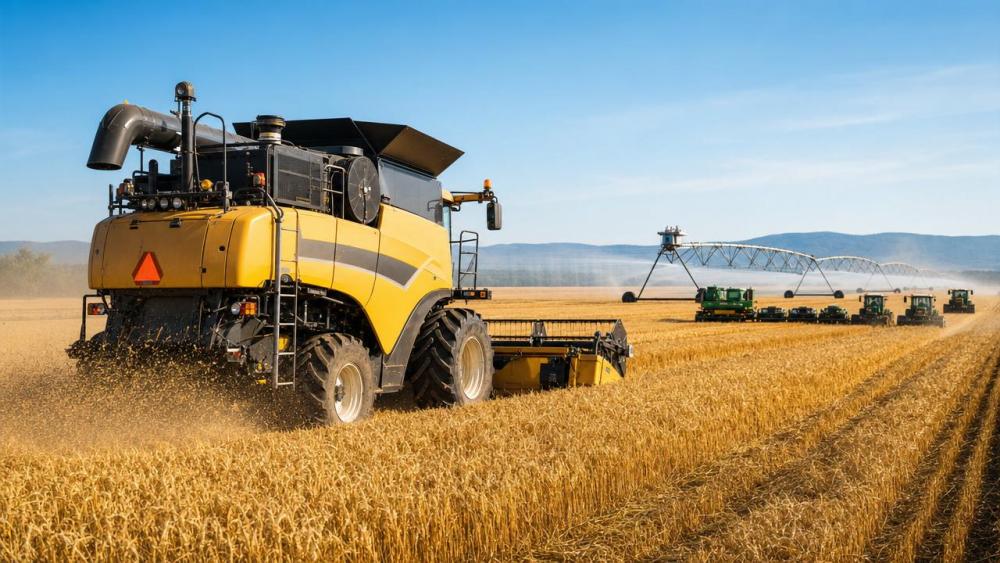
Farm downtime is costly because agriculture operates inside narrow biological, seasonal, and market windows that cannot be easily delayed or recovered.
A failed harvester during peak season can reduce crop quality, increase labor costs, delay logistics, and weaken customer commitments across the supply chain.
For manufacturers, downtime also affects brand reputation, warranty exposure, dealer service capacity, and future purchasing decisions from enterprise customers.
The central business question is no longer whether equipment will fail, but how early a farm system can detect and prevent that failure.
Industrial automation gives decision makers a practical way to move from reactive maintenance toward condition-based operations supported by real-time data.
Where industrial automation actually reduces stoppages
The strongest downtime reductions usually come from automating visibility, alerts, diagnostics, machine coordination, and maintenance planning across critical assets.
Sensors monitor vibration, temperature, hydraulic pressure, engine load, fuel consumption, belt tension, and electrical performance before visible failure occurs.
Automation platforms translate those signals into warnings, maintenance recommendations, or automatic adjustments that prevent small deviations from becoming breakdowns.
On tractors, combines, sprayers, irrigation systems, and grain handling lines, these capabilities reduce both sudden failures and performance-related slowdowns.
For large farms and contractors, the value increases when equipment fleets are managed centrally instead of through isolated operator observations.
Predictive maintenance is the highest-value starting point
For most agribusiness leaders, predictive maintenance delivers the clearest return because it targets expensive failures and avoids unnecessary service intervals.
Instead of replacing components purely by calendar schedule, automated systems estimate wear based on real operating conditions and historical failure patterns.
This matters because two identical machines may experience very different stress levels depending on soil type, slope, crop density, operator behavior, and weather.
Industrial automation helps maintenance teams prioritize the equipment most likely to fail, especially during planting, spraying, harvesting, or post-harvest handling.
The business benefit is not only fewer repairs, but better timing of repairs when labor, parts, and substitute machines are available.
Manufacturers can also use aggregated service data to improve product design, refine warranties, and offer premium uptime-focused support packages.
Real-time monitoring turns hidden machine stress into decisions
Many farm failures are not truly sudden; they are the final stage of a condition that was developing unnoticed over time.
Real-time monitoring makes those conditions visible by continuously collecting operating data from engines, transmissions, hydraulics, implements, and onboard control systems.
When thresholds are exceeded, managers can receive alerts before damage spreads to more expensive components or stops the entire operation.
For example, abnormal hydraulic temperature may indicate contamination, low fluid, pump strain, or a filter problem requiring immediate attention.
Without automation, the issue may only be discovered after reduced implement performance or a complete system shutdown in the field.
For decision makers, this converts maintenance from a guessing exercise into a measurable operational discipline with auditable data.
Automation improves field efficiency, not just maintenance
Downtime is not limited to mechanical failure; it also includes waiting, rework, poor routing, machine mismatch, and operator-dependent inconsistency.
Automated steering, variable-rate application, implement control, and fleet coordination reduce wasted passes and help machines work closer to optimal capacity.
When equipment communicates with job plans and field maps, operators spend less time correcting overlaps, misses, blockages, or calibration errors.
That matters during time-sensitive operations where small inefficiencies across many acres accumulate into delayed completion and higher resource use.
For executives, the key insight is that automation reduces downtime by improving the entire operating rhythm, not only by fixing breakdowns.
How automation supports parts, service, and dealer networks
Farm downtime often extends because the right technician, diagnostic information, or replacement part is unavailable when failure occurs.
Connected equipment can transmit fault codes, operating context, and component history before a technician arrives, reducing diagnosis time significantly.
Dealers can prepare parts in advance, assign specialists more accurately, and schedule service based on actual urgency rather than customer descriptions.
Manufacturers gain a clearer view of common failure modes across regions, machine models, crops, and operating environments.
This creates a feedback loop where automation strengthens aftermarket service, product development, inventory planning, and customer retention simultaneously.
For enterprise buyers, uptime-focused service capability can become a decisive factor when comparing equipment suppliers.
The financial case: what leaders should measure
Industrial automation should be evaluated through measurable business outcomes, not only technical features or marketing claims.
Useful metrics include machine availability, mean time between failures, mean time to repair, missed operating hours, repair cost per acre, and yield impact.
Decision makers should also measure indirect costs such as overtime labor, idle logistics assets, delayed delivery penalties, and emergency parts premiums.
A strong automation case usually appears when downtime costs are concentrated in short seasonal windows with limited recovery options.
For manufacturers, the return may include reduced warranty claims, higher service revenue quality, stronger customer loyalty, and better lifecycle product intelligence.
The most credible investment models compare automation costs against avoided failures, reduced service visits, better asset utilization, and improved operational predictability.
When industrial automation delivers the greatest impact
Automation does not create equal value in every farm setting, so leaders should identify the operations where downtime is most damaging.
Large-scale row crop operations, high-value specialty crops, livestock feed systems, irrigation networks, and grain handling facilities often benefit strongly.
Contractors and custom operators also gain because equipment availability directly affects revenue, client satisfaction, and seasonal workload capacity.
Automation is especially valuable where labor is scarce, machines are highly utilized, or operators have varying levels of technical experience.
In smaller operations, the best entry point may be targeted monitoring for critical assets rather than a full automation transformation.
The right strategy depends on failure history, equipment age, crop value, service access, and the organization’s ability to act on data.
Key risks and implementation barriers to manage
Industrial automation can reduce downtime, but poor implementation may create new complexity, weak adoption, or unreliable decision-making.
Common barriers include fragmented data systems, limited connectivity, incompatible equipment brands, unclear ownership of alerts, and insufficient technician training.
Leaders should avoid collecting data without defining who reviews it, what actions follow, and how success will be measured.
Cybersecurity also matters as connected machines, cloud platforms, and remote diagnostics become part of critical agricultural infrastructure.
Another risk is over-automation without operator trust, especially if alerts are frequent, vague, or disconnected from practical field conditions.
The best deployments combine automation with clear workflows, service accountability, data governance, and continuous feedback from operators and maintenance teams.
A practical roadmap for decision makers
The most effective approach begins with a downtime audit, identifying which machines, processes, and seasons create the highest financial exposure.
Next, leaders should rank assets by criticality, repair cost, replacement difficulty, utilization rate, and impact on production commitments.
Automation should then be piloted on a focused use case, such as monitoring combines during harvest or irrigation pumps during peak demand.
A pilot should include baseline data, clear uptime targets, defined response procedures, and feedback from operators, technicians, and managers.
After proving value, the system can expand into fleet-wide predictive maintenance, automated dispatch, service integration, and performance benchmarking.
Manufacturers should consider building automation into product strategy rather than treating connectivity as an optional accessory.
What this means for equipment manufacturers
For manufacturers, industrial automation changes the competitive basis from selling machines to supporting measurable uptime and lifecycle performance.
Customers increasingly expect equipment to generate operational intelligence, integrate with farm management platforms, and support faster remote diagnostics.
This creates opportunities for differentiated service contracts, software-enabled maintenance models, subscription insights, and stronger dealer collaboration.
It also pressures manufacturers to design machines with sensor access, data interoperability, cybersecurity, and maintainability in mind from the beginning.
Those that master uptime intelligence can build closer relationships with large agribusiness customers and reduce reliance on replacement-cycle sales alone.
Conclusion: automation turns downtime into a manageable variable
Industrial automation cuts farm downtime by detecting risk earlier, coordinating work better, and helping teams act before failures disrupt production.
Its value is strongest when connected to real business outcomes, including machine availability, seasonal reliability, repair efficiency, and customer commitments.
For agribusiness leaders, the priority is not adopting every technology, but targeting the downtime points that threaten margins and supply reliability.
For manufacturers, automation is becoming central to product value, service differentiation, and long-term customer trust in agricultural machinery.
In a more volatile food system, resilient farms will be those that treat uptime as a strategic capability, not a maintenance afterthought.