




Search
Related News
- 00
0000-00
When life sciences for biotechnology improve dietary supplement formulation - 00
0000-00
What drives the pricing of food policy trends analysis? - 00
0000-00
How supply-chain disruptions reshape Global Food Systems North America - 00
0000-00
What is driving the nutritional genomics market in Latin America? - 00
0000-00
What processing service information should be confirmed before outsourcing?
Tags
Edible Oil Storage Tank Design Factors for Hygienic Processing




Byline: Editorial Desk, Food Process Equipment Review
Review Note: Prepared for food oil processors and procurement teams comparing hygienic storage tank configurations.
Edible oil storage is not only a matter of holding product between processing and filling. For food processors, the tank is part of the hygiene system, the temperature-control system, the product protection plan, and the daily production schedule. A poorly specified tank can slow filling, make cleaning harder, increase oxidation risk, or create unnecessary operator work. A well-matched tank helps the plant move oil through the process with fewer quality surprises and a more predictable workflow.
Buyers searching for a sunflower oil storage tank often compare capacity and price first. Those are practical concerns, but they do not tell the full story. Sunflower oil, salad oil, palm oil, coconut oil, blended cooking oil, and specialty food oils can have different viscosity behavior, temperature needs, cleaning expectations, and sensitivity to air exposure. Tank design should therefore be reviewed through the lens of actual product handling, not only through nominal volume.
This article outlines the main design factors that food processors should examine before purchasing an edible oil tank. It focuses on sanitary construction, material selection, heating and insulation, nitrogen blanketing, drainage, cleaning access, layout, and documentation. The aim is to support practical buying decisions without relying on unsupported performance claims or generic equipment language.
Start With the Oil, Not the Tank Size
Capacity is important, but product behavior should guide the tank conversation first. Some edible oils remain easy to pump at ambient temperature, while others need controlled heating to stay workable. Some products are sensitive to oxygen pickup, light exposure, moisture, or flavor carryover. A plant that handles one stable product has different needs from a processor that changes oil types during the week.
Before asking suppliers for a quotation, buyers should list the oils to be stored, the expected incoming temperature, the target discharge temperature, the maximum holding time, the downstream filling or processing rate, and the cleaning method. These details help determine whether the tank needs a heating jacket, insulation, a conical or sloped bottom, specific fittings, nitrogen protection, or more inspection access.
For a sunflower oil storage tank, many plants focus on clean storage, stable discharge, and simple sanitation. The design still needs to match local operating reality. If the plant receives oil in bulk and fills retail containers in batches, the tank may need to buffer product between delivery and filling. If the tank is part of a processing line, outlet placement, flow rate, and pump compatibility become more important.
Sanitary Stainless Steel Construction
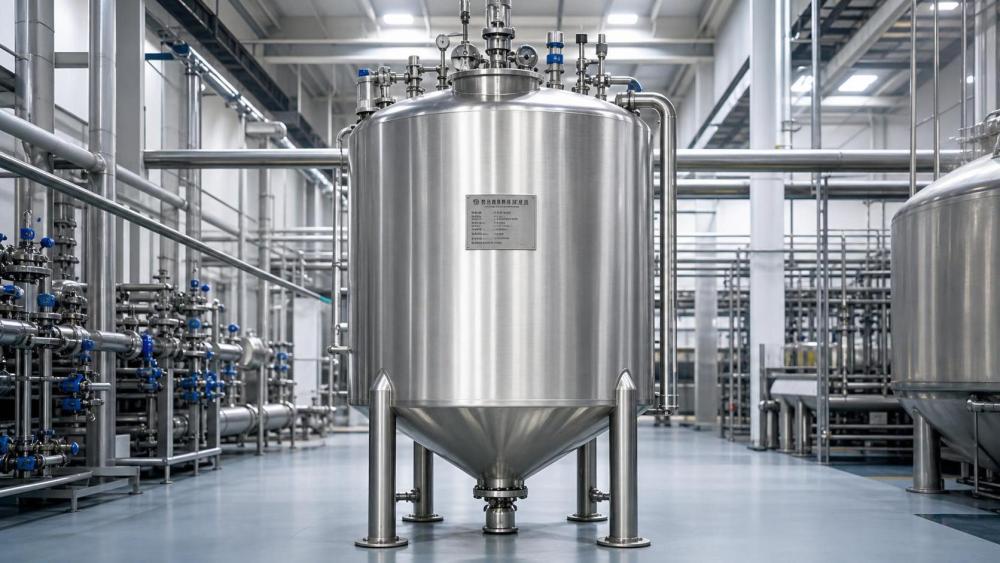
Food-contact construction is one of the first checkpoints. Stainless steel is widely used for edible oil service because it supports hygiene, durability, and easier cleaning compared with many alternative materials. Buyers should still clarify the steel grade, product-contact finish, welding quality, gasket material, and the way fittings are installed. A tank may look clean from the outside while still having internal details that complicate drainage or inspection.
Smooth internal surfaces help reduce residue retention. Welds should be suitable for food-contact equipment and should not create unnecessary crevices. Inlet and outlet fittings should be positioned for the plant's process, not simply placed where fabrication is easiest. Manways, vents, sampling ports, temperature sensors, level instruments, and cleaning connections should be reviewed as part of the same sanitary system.
Buyers should ask suppliers how product-contact surfaces are finished, how weld areas are treated, what gasket materials are recommended for the oil and cleaning media, and which parts require routine inspection. These questions are practical because the tank will be cleaned, opened, inspected, and maintained repeatedly after installation.
Heating, Insulation, and Temperature Control
Temperature control depends on the oil type and the plant's handling plan. Some edible oils do not require active heating in normal conditions. Others may need heating to maintain flow, avoid crystallization, or prepare for downstream processing. Heating can be provided through a jacket, coil, external circulation, or another plant-specific approach. The right choice depends on viscosity, product sensitivity, heating medium, and cleaning requirements.
Heating should be controlled rather than aggressive. Uneven heating can create local quality problems, especially when product is held for longer periods. Insulation may reduce heat loss and help operators maintain a steadier tank condition. Temperature sensors should be positioned where they provide useful process information, not only where they are convenient to install.
Buyers should define the required operating temperature range, acceptable warm-up time, cleaning temperature, and whether the tank must hold product overnight. These factors influence the heating surface, insulation thickness, control panel requirements, and utility preparation. A supplier cannot design a practical heating system without knowing the process target.
Oxidation Control and Nitrogen Protection
Oxygen exposure can affect the quality of many edible oils. The level of risk depends on product type, storage time, headspace, temperature, turnover rate, and packaging plan. Some plants use nitrogen blanketing to reduce oxygen contact in the tank headspace. Others rely on short holding times and controlled handling. The correct approach should be based on product sensitivity and food safety procedures rather than habit.
If nitrogen blanketing is required, the tank design should include suitable connections, pressure control, venting, and operating instructions. The plant also needs to prepare the nitrogen source and confirm safe handling procedures. Blanketing is not just a fitting on the top of the tank; it is a control method that should be understood by operators.
For buyers comparing an edible oil storage tank, the key question is how the tank supports product protection during real storage conditions. A tank used for fast turnover may require different headspace management than a tank used for longer holding. The supplier should explain what is included and what the plant must provide separately.
Cleaning and Drainage Design
Cleaning should be discussed early because edible oil residue can be difficult to remove if the tank has poor drainage or awkward internal geometry. Buyers should confirm whether the tank is cleaned manually, by spray device, by CIP connection, or by a combined method. The cleaning plan should match the product, the plant's sanitation standard, and the available utilities.
Drainage is especially important. A tank bottom should help remove product and cleaning liquid rather than trap it. Outlet position, bottom slope, dead legs, pump connection, and valve selection all affect how much residue remains after discharge. If operators need to spend excessive time clearing remaining oil, the tank may become a daily labor problem.
Cleaning access also affects safety. A manway may be necessary for inspection, but confined-space procedures and plant safety rules must be considered. External ladders, platforms, guardrails, and access points should be reviewed during layout planning, not improvised after installation.
Practical Design Checklist
Layout and Installation Planning
A tank that is technically suitable can still create problems if the layout is not planned. Buyers should confirm the installation area, foundation, tank height, maintenance clearance, pipe routing, cleaning drain location, pump position, and access for operators. If the tank is installed near a filling line, the discharge route and production rhythm should be considered together.
Utilities should also be checked. Heating may require steam, hot water, thermal oil, or electricity. Cleaning may require hot water, detergent, sanitizer, compressed air, or drain capacity. Nitrogen protection requires gas supply and safe control. Level measurement and temperature control require electrical and control connections. Confirming these items before ordering reduces installation delays.
For export projects, documentation can be just as important as the tank itself. Buyers should ask for drawings, material information, connection lists, operating notes, maintenance guidance, and packing information. Documentation helps the receiving plant prepare the site and train operators before the equipment is put into use.
Supplier Questions Before Purchase
Procurement teams should ask suppliers to explain how the tank design matches the specific oil and process. Useful questions include: What internal finish is provided? How is the bottom designed for drainage? Which heating method is recommended for the oil? Can the tank support nitrogen blanketing if needed? What cleaning method is expected? Which valves, fittings, and instruments are included? What utilities must the plant prepare?
Buyers should also ask what information the supplier needs before finalizing the design. A responsible supplier will usually request product details, process temperature, capacity target, connection preferences, cleaning method, and site layout. If a supplier offers a final configuration without asking process questions, the buyer should review the proposal carefully.
Common Mistakes to Avoid
The first mistake is treating the tank as a simple container. In edible oil processing, the tank affects hygiene, product quality, flow control, and scheduling. The second mistake is ignoring cleaning and drainage until after installation. A tank that is hard to empty or clean can create daily friction for operators.
Another mistake is selecting heating without understanding the product. Too little heating may slow production, while poorly controlled heating may affect product quality. Buyers should define the target temperature profile and ask how the system will maintain it. Finally, plants should avoid buying a tank without checking layout restrictions. Height, access, pipe routing, and drainage can all affect whether the tank works smoothly in the real facility.
FAQ
Is every edible oil tank suitable for sunflower oil?
Not automatically. A sunflower oil storage tank should be reviewed for sanitary construction, drainage, temperature needs, oxidation control, and the plant's filling or processing workflow.
Does an edible oil storage tank always need heating?
No. Heating depends on the oil type, ambient conditions, viscosity, discharge needs, and process temperature. Buyers should define the handling target before choosing a heating method.
When should nitrogen blanketing be considered?
Nitrogen blanketing may be considered when oil quality is sensitive to oxygen exposure or when holding conditions make headspace control important. The decision should be based on product and process requirements.
What information should be prepared for a tank quotation?
Prepare oil type, capacity, operating temperature, cleaning method, desired fittings, discharge requirements, available utilities, and site layout. These details help the supplier recommend a more suitable configuration.
Conclusion
Edible oil tank selection should begin with the product and process, then move into construction details, heating, cleaning, oxidation control, and installation planning. A tank that fits the plant's real operating conditions can support hygienic processing, steadier production, and simpler maintenance. For buyers comparing proposals, the best decision comes from asking practical questions about how the tank will be filled, held, cleaned, discharged, and inspected every day.
Related News
- How to choose a beverage processing equipment supplier for hygienic productionAug 17, 2026Beverage processing equipment supplier selection starts with hygiene. Learn how to assess sanitary design, CIP performance, compliance, and support for safer, more efficient production.
- How to Choose Automatic Filling Equipment Based on Product Viscosity and OutputAug 10, 2026Automatic filling equipment selection starts with viscosity and output. Learn how to match pumps, nozzles, hygiene needs, and line speed for better accuracy, uptime, and ROI.
- Application Scenario Analysis in Beverage Production: Matching Process Needs to Filling Line DesignAug 02, 2026Application scenario analysis beverage production starts by defining product, package, hygiene, and output realities. Learn how to match process needs to filling line design and avoid costly selection mistakes.
- India Replaces Import Licenses With BIS RegistrationJul 14, 2026India replaces import licenses with BIS registration for beverage filling equipment. Learn how IS 17921:2026 and the 30-day local calibration filing affect compliance, delivery, and market access.