




Search
Related News
- 00
0000-00
What drives the pricing of food policy trends analysis? - 00
0000-00
How supply-chain disruptions reshape Global Food Systems North America - 00
0000-00
What is driving the nutritional genomics market in Latin America? - 00
0000-00
What processing service information should be confirmed before outsourcing? - 00
0000-00
Can an Agricultural Trade Insights dashboard flag supply risks early?
EU Ends 150-Euro De Minimis From July 2026




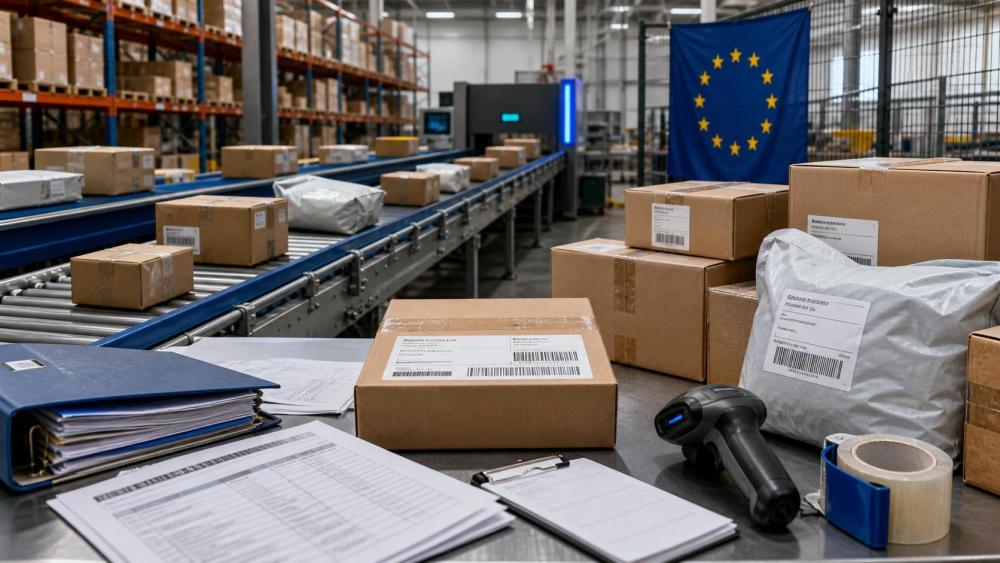
From 2026-07-01, the EU will end the customs duty exemption for low-value cross-border parcels below 150 euros, while applying a unified 3-euro clearance fee to individual consumer goods sent directly into the EU. Temu, SHEIN, AliExpress and similar platforms are to be treated as import-responsible entities, with obligations covering duty payment, product compliance and verification of origin authenticity. For China-linked export flows in fast-moving consumer goods, packaging systems, infant products and dietary supplements, this is a rule change that directly affects clearance pace, cost structure and channel-entry compliance.
What the new rule changes
The confirmed facts are straightforward: the policy takes effect on 2026-07-01, the EU will remove the 150-euro tax exemption for low-value parcels, a 3-euro clearance charge will apply to each direct-to-consumer item, and major cross-border platforms are being assigned import-side responsibility. The stated compliance scope covers duty settlement, product compliance and verification of origin authenticity.
Where the pressure will show up first
Platform-led cross-border trade will carry more responsibility
At the platform level, the main change is that marketplace operators can no longer be viewed only as traffic or transaction intermediaries. If the stated obligations are implemented as described, they will need to manage customs payment, compliance review and origin checks more actively. That may reshape how products are listed, documented and routed before shipment.
Exporters will face tighter document discipline
For exporters shipping into the EU, the practical impact is likely to fall on declaration consistency, product records and traceability materials. Analysis suggests that any gap between declared origin, product identity and supporting documents will matter more, because the rule explicitly ties platform responsibility to origin authenticity verification and product compliance.
Fast-moving consumer categories may see the earliest operational impact
The categories named in the input, including fast-moving consumer goods, packaging systems, infant products and dietary supplements, are likely to feel the change first in clearance timing and compliance checks. That does not mean every SKU will be treated the same, but it does mean these lines will need closer review of unit classification, supporting documents and seller-side readiness.
What companies should check now
Review product files before shipment
Companies should verify that product descriptions, origin records and compliance documents are internally consistent. Where products enter the EU through direct-to-consumer channels, the document set should be ready for customs review and platform-level compliance validation.
Recheck platform and channel allocation
For businesses using Temu, SHEIN, AliExpress or similar channels, it is prudent to assess whether the current fulfillment and declaration setup can support the new responsibility model. At this stage, the key question is not only sales conversion, but whether the channel structure can handle duty payment and compliance verification without disrupting delivery schedules.
Reevaluate cost and lead-time assumptions
The fixed 3-euro clearance fee and the removal of the previous exemption change the landed-cost picture for low-value parcels. That makes it necessary to revisit pricing, procurement timing and inventory planning, especially where margins are thin and parcel turnover is high.
How to read the signal
From an industry perspective, this should be understood as a clear execution signal rather than a vague policy direction. The input does not provide the underlying legal text or enforcement guidance, so the exact implementation details still deserve close watching. What matters now is that the EU is signaling a tougher import-control posture for low-value direct parcels, with platforms pushed into a more formal compliance role.
What deserves closer attention next is the execution口径 for customs processing, how platform liability will be applied in practice, and whether category-specific documentation expectations become more demanding. For exporters, the immediate task is to treat this as a compliance and routing issue, not just a fee adjustment.
What this means in practice
The main takeaway is that low-value parcel trade into the EU is moving into a stricter cost-and-compliance environment. For affected businesses, the relevant response is to check product records, verify origin evidence, confirm platform responsibilities and review landed-cost assumptions before the rule date. This is best treated as a policy change with direct operational consequences, while the finer execution details still need to be confirmed through official guidance and market practice.
Source note
This article was generated from the user-provided title, event date and event summary. No specific official source link was provided in the input. For events of this type, relevant source categories would normally include official announcements, regulatory authority releases, customs or trade authority notices, industry association updates and authoritative media reports. Further verification should continue around policy details, compliance execution, platform enforcement, trade handling and industry feedback.
Related News
- How to compare packaging system solutions for frequent product changeoversSep 21, 2026Compare packaging system solutions for frequent product changeovers. Learn how to assess flexibility, sanitation, labor, recipes, and real-world line performance.
- When does packaging system scalability justify a larger initial investment?Sep 20, 2026Packaging system scalability: discover when a higher upfront investment reduces future downtime, supports growth, adds format flexibility, and protects long-term profitability.
- Which packaging cost analytics metrics reveal avoidable line waste?Sep 20, 2026Packaging cost analytics reveals avoidable line waste through material variance, yield loss, changeover costs, downtime links, and cost per good unit—helping finance prioritize high-return improvements.
- How to assess a food packaging technology manufacturer’s line integration capabilitySep 14, 2026Learn how to assess a food packaging technology manufacturer’s line integration capability, from throughput and controls to hygiene, testing, and support.