




Search
Related News
- 00
0000-00
How agri-tech forecasting data can improve planting decisions - 00
0000-00
What the Global Nutrition Trends dashboard reveals about supplement demand - 00
0000-00
When pilot production is needed before scaling a food process - 00
0000-00
What to verify before selecting a food engineering manufacturer - 00
0000-00
How to verify supplier production capacity in Southeast Asia
Tags
Chicken Cage Design Factors That Help Reduce Egg Breakage




Chicken Cage Design Factors That Help Reduce Egg Breakage
Egg breakage remains one of the most visible indicators of how well a layer housing system is designed, installed, and maintained. For producers, broken eggs mean lost saleable output, more labor for cleanup, a higher hygiene burden, and a greater chance that small defects in equipment will turn into recurring operational losses. For buyers, technical managers, and quality teams, breakage rates can also reveal whether a housing system is truly engineered for real production conditions rather than only for nominal capacity.
In modern poultry operations, the issue is no longer limited to obvious mishandling. It is increasingly tied to mechanical details inside the housing unit itself: wire floor angle, egg rolling path, cage depth, vibration transfer, cushioning at collection points, and tolerance control during fabrication. When these variables are not aligned, eggs may collide, stall, rotate unpredictably, or arrive at the front edge with excessive speed. Each event may look minor, but repeated over thousands of eggs per day, the cumulative effect can become commercially significant.
That is why discussions about Chicken cage design have moved beyond simple durability or stocking density. In many purchasing and retrofit decisions, the more important question is how the mechanical behavior of the system supports gentle egg handling from the moment the egg is laid to the moment it reaches collection. This is especially relevant for operators seeking stable grading performance, for technical evaluators comparing equipment layouts, and for maintenance teams responsible for keeping line accuracy consistent over time.
Why the Breakage Problem Deserves Closer Attention
Eggshell strength varies with bird age, nutrition, flock health, and environmental conditions, but equipment design determines how much stress the egg experiences after laying. Even a sound shell can crack if impact loads are concentrated at a single contact point or if rolling motion is interrupted by uneven surfaces. In practice, many breakage problems are caused not by one dramatic defect, but by a chain of small mechanical inefficiencies that increase the probability of damage.
For integrated farms and commercial egg businesses, this has wider implications. A higher breakage rate affects pack-out consistency, labor allocation, and sanitation protocols. It may also complicate root-cause analysis because broken eggs can result from bird factors, handling procedures, or cage geometry at the same time. If decision-makers focus only on shell quality while ignoring equipment mechanics, corrective action may remain incomplete.
Manufacturers face similar pressure. End users increasingly expect housing systems to deliver not just capacity, but predictable product flow with low mechanical stress. As farms become more automated, tolerance errors that once seemed manageable can create larger downstream issues because eggs now pass through tightly linked handling stages. A cage design that performs adequately in a simple manual environment may not perform equally well in a higher-throughput automated line.
The Role of Floor Slope in Egg Movement
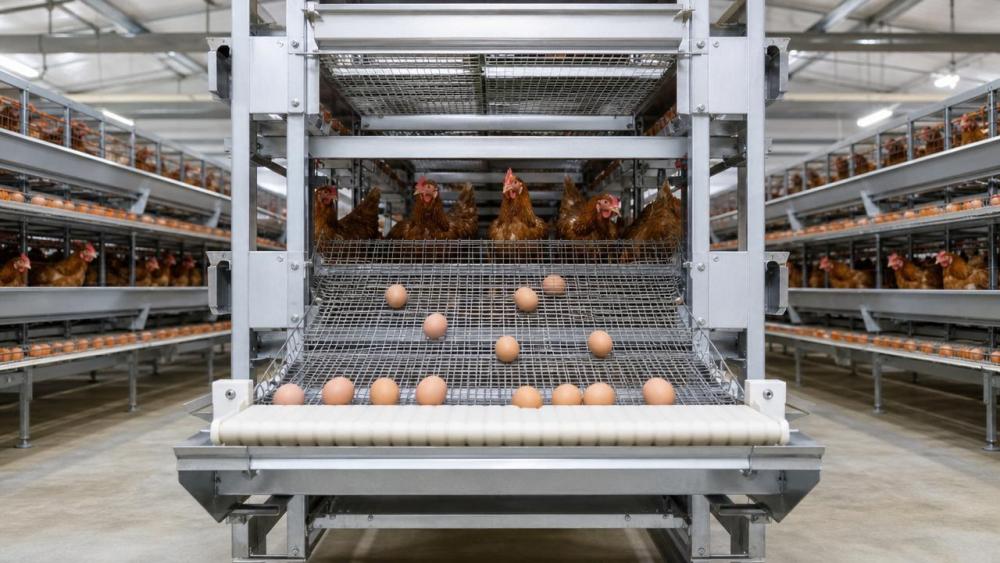
Among all design variables, floor slope is one of the most critical. The wire bottom must be angled enough to allow eggs to roll toward the collection edge soon after laying, but not so steep that the egg gains excessive speed. If the slope is too low, eggs may remain in the laying area longer, increasing the chance of pecking, stepping, contamination, or collision with subsequent eggs. If the slope is too high, the rolling egg can strike the front edge or another egg with damaging force.
From a mechanical standpoint, the goal is controlled transfer rather than rapid transfer. The egg should move smoothly under gravity with minimal bounce and limited rotational instability. This requires more than simply setting an angle during design. It also depends on how accurately the installed cage maintains that angle under live load, how the wire mesh supports the egg at multiple contact points, and whether deformation occurs after long periods of use.
Technical evaluators often benefit from asking several practical questions:
- Does the floor maintain a consistent slope across all tiers and rows?
- Are there local depressions or high spots that interrupt rolling behavior?
- Is the wire spacing appropriate for shell support without trapping smaller eggs?
- Does the front collection area receive the egg at a controlled speed?
These questions matter because a nominal design specification is not the same as real operating geometry. In many cases, installation quality and structural stiffness determine whether the intended slope actually works in the field.
Why Cushioning and Buffering Matter at the Collection Edge
Another major factor is the transition point where the rolling egg reaches the front of the cage. This is where impact energy tends to concentrate. If the egg meets a hard wire edge, a poorly positioned stop, or another egg already resting in the collection zone, shell damage becomes more likely. Buffering elements are therefore not cosmetic additions; they serve a direct mechanical purpose by reducing peak contact stress and moderating collision energy.
A well-designed cushioning solution usually works in combination with the floor angle. When the slope brings the egg forward at an appropriate speed, the buffer can absorb or redistribute the remaining energy. If the slope is already too aggressive, however, even a soft buffer may not fully prevent damage. This is why the best-performing systems typically treat the rolling path and the collection edge as one integrated motion-control problem rather than two separate parts.
For operations teams, attention should also be paid to wear over time. Some buffering materials may harden, shift, or lose consistency after prolonged exposure to dust, cleaning routines, and daily friction. Maintenance personnel should not only check whether a buffer exists, but whether it still performs as intended under repetitive use. Small deviations in position or material condition can change egg landing behavior significantly.
Depth, Precision, and High-Density System Challenges
As poultry housing moves toward higher density and more intensive space utilization, cage geometry becomes more demanding. Deeper systems may improve layout efficiency, but they also extend the egg rolling path and increase the number of factors that must stay mechanically stable. H-type high-density stacked cages often require tighter manufacturing and installation precision because the greater depth can magnify small errors in angle, wire flatness, and front-edge alignment. Readers comparing broader market trends may also find useful context in Why Layer Cage Systems Are Gaining Ground in Emerging Poultry Markets.
In deeper systems, eggs may travel farther before reaching the collection area, which raises the importance of controlling friction, vibration, and path uniformity. If the floor is not uniform from rear to front, eggs can wobble, slow unexpectedly, or change direction. In stacked layouts, additional attention may be needed to ensure that assembly tolerances remain consistent from tier to tier, because variation in one level can produce different breakage patterns than another, making troubleshooting more complex.
For buyers and engineering teams, this means that higher capacity should not be assessed only in terms of bird numbers per building. The more useful assessment is whether structural precision, field assembly control, and maintenance access are sufficient to preserve gentle egg handling under dense operating conditions.
Common Mechanical Causes of Breakage Often Overlooked
Several recurring issues tend to escape attention during specification reviews because they appear minor in isolation. Yet each can contribute to product loss:
- Uneven wire tension that creates localized bumps or sagging zones.
- Joint misalignment that disrupts the rolling path near cage transitions.
- Excess vibration from adjacent mechanical equipment or poor structural fixation.
- Front collection areas that allow eggs to cluster and collide.
- Component wear that gradually changes angles and contact surfaces.
None of these problems necessarily indicates a complete design failure. More often, they show why breakage control depends on the interaction between design, fabrication quality, installation discipline, and routine inspection. A technically sound system still requires mechanical consistency in everyday use.
What Procurement and Quality Teams Should Evaluate
When comparing cage systems, procurement and quality teams usually benefit from moving beyond brochure-level features and examining how the equipment manages egg movement in practice. The following areas are often worth close review:
This type of review can help users distinguish between systems that merely move eggs forward and systems that do so with consistent low-impact handling. For quality and safety managers, this is also relevant to hygiene control because fewer breakages generally mean fewer contamination points inside the production flow.
Execution Priorities on the Farm Floor
Even a well-specified system needs disciplined execution after purchase. Installation checks should verify slope consistency, cage leveling, front-edge alignment, and the condition of any cushioning components before birds are fully stocked. During operation, teams may benefit from tracking where broken eggs appear most often, because location patterns often reveal whether the issue is tied to a particular row, tier, or structural deviation.
Maintenance staff should also treat breakage as a mechanical diagnostic signal, not only as an output problem. If one section shows a different pattern than another, the cause may lie in mounting stability, mesh deformation, or collection-point wear rather than flock performance alone. This approach can make corrective action faster and more targeted.
A More Technical View Leads to Better Decisions
Reducing egg breakage is not simply a matter of adding softer materials or adjusting one visible parameter. It depends on how the full cage design manages force, motion, and contact from laying to collection. Floor slope, wire support, rolling distance, front-edge buffering, and dimensional precision all interact to influence shell survival.
For operators, engineers, and buyers in the livestock machinery sector, the practical takeaway is clear: a housing system should be judged not only by capacity or layout efficiency, but by how well its mechanics protect a fragile product under daily production conditions. In many commercial settings, that technical difference can shape both product quality and long-term operating stability.
Related News
- Choosing Agricultural Machinery for Tillage by Soil Type and Fuel CostJul 11, 2026Agricultural machinery for tillage should match soil type and fuel cost. Discover practical tips to cut operating expenses, protect soil, and choose equipment with better long-term value.
- How to Compare Machinery in Middle East by Uptime, Support, and Total CostJul 09, 2026Machinery in Middle East comparison starts with uptime, support, and total cost—not price alone. Learn how to choose reliable suppliers, reduce downtime risk, and improve long-term value.
- Construction Machinery Parts: Cost Drivers and Sourcing RisksJul 06, 2026Construction machinery parts cost more than unit price alone. Explore key cost drivers, supplier risks, logistics challenges, and smart sourcing tactics to reduce downtime and improve long-term value.
- Agri-Tech Solutions Equipment: Key Costs Before You InvestJul 02, 2026Agri-Tech Solutions equipment costs go beyond the purchase price. Discover hidden expenses, ROI risks, and smart investment checks before you commit.