




Search
Related News
- 00
0000-00
How nutritional security assessment identifies gaps in local diets - 00
0000-00
How to assess a food packaging technology manufacturer’s line integration capability - 00
0000-00
Which industrial equipment cost factors matter most before approval? - 00
0000-00
What determines the price of an automated feeding system? - 00
0000-00
How to qualify a specialty chemicals manufacturer for food-contact formulations
Tags
Homemade Laying Hen Cages: Materials, Dimensions, and Safety Checks




Building a Homemade Cage Starts with the Management System
A homemade laying-hen cage is not simply a wire box with a feeder attached. Its dimensions, floor angle, wire gauge, door placement, manure clearance, and access to water all affect daily egg collection, bird condition, cleaning time, and the likelihood of injury. Small mistakes can create recurring operational problems: cracked eggs from poor roll-out angles, foot lesions from unsuitable flooring, hens trapped at doors, or corrosion that weakens the frame before the unit has delivered its expected service life.
Before cutting wire or buying steel, the operator should decide what the cage is meant to do. A unit for a few birds in a sheltered backyard has different demands from a multi-tier structure in a humid poultry house. Local animal-welfare rules may also limit or prohibit particular cage designs, especially conventional restrictive cages. Requirements vary by country, region, and production system, so a design should be checked against the applicable local rules before installation. The World Organisation for Animal Health (WOAH) notes that housing systems should be designed and managed to minimize injury, disease risk, stress, and harmful social interactions among birds (WOAH, Terrestrial Animal Health Code, Chapter 7.10, “Animal Welfare and Laying Hen Production Systems”).
The practical question is not whether a cage can be made from inexpensive materials. It is whether the finished structure can be cleaned, inspected, operated safely, and maintained without creating avoidable welfare or food-handling problems.
Choose Materials for the Actual House Environment
Material selection is usually where a homemade cage succeeds or fails over time. Low-cost materials can be appropriate for a temporary or very small installation, but operators should calculate the full working environment: moisture, ammonia exposure, manure accumulation, rodent activity, frequency of washing, and the weight carried by tiers, feeders, drinkers, and birds.
Wire mesh: floor, sides, and egg collection areas
Welded wire mesh is generally easier to inspect than loosely woven mesh because damaged welds, sharp ends, and deformed openings are more visible. The floor needs enough stiffness to avoid sagging under birds while remaining comfortable enough to reduce pressure on the feet. A floor that flexes heavily can disturb the egg roll path and create low spots where manure collects. An overly rough or poorly finished wire surface can increase the risk of abrasions and foot damage.
Mesh opening size should be chosen around bird size, foot support, and manure passage rather than copied from a generic online diagram. Large openings may improve manure drop-through but can leave feet insufficiently supported. Very small openings are harder to clean and may retain more debris. All cut edges should face away from the bird area, be folded over, or be covered with a suitable protective finish. A cut wire end is not a minor cosmetic issue when hens repeatedly move along the same route to feed, drink, lay, and rest.
Galvanized wire and galvanized steel framing are often selected because poultry-house humidity can corrode untreated steel quickly. However, “galvanized” is not a complete quality description. Operators should examine coating continuity at welded points, bends, fastener holes, and cut ends. These locations commonly become the first corrosion sites. If a cage will be regularly washed, frame joints and support legs deserve the same attention as the wire panels.
Frame, supports, and fasteners
A simple single-level cage can sometimes use a timber frame, provided the wood is dry, structurally sound, and protected from persistent dampness. Yet wood absorbs moisture, is harder to disinfect thoroughly, and can hide insect activity or rot. For installations expected to stay in service through multiple flock cycles, a metal frame is often easier to wash, inspect, and repair.
Use bolts, washers, and lock nuts where access for later tightening is useful. Rivets and permanent welds can work, but they make replacement of damaged sections more difficult. Avoid relying on thin tie wire as a primary structural connection. It may hold a panel in place during assembly, but repeated vibration from birds, egg collection, and cleaning can loosen it. The frame should transfer load to the floor through adequately braced legs rather than through mesh panels alone.
Plastic components can be useful for drinker pipes, cup supports, and feeder liners, but brittle plastics are a risk in strong sun or where cleaning chemicals are used. Any plastic placed inside the bird area should have smooth edges and be secured so that it cannot become a pecked, broken, or swallowed fragment.
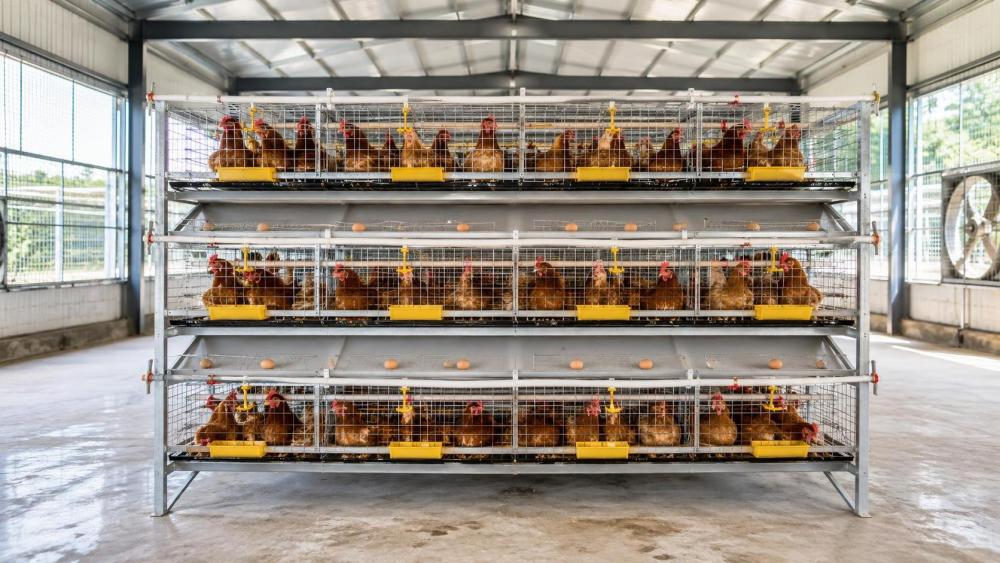
Dimensions Must Balance Bird Space and Operator Access
There is no universal homemade-cage dimension that is suitable everywhere. Bird strain, body weight, cage layout, legal requirements, climate, and whether the system is used for short-term holding or continuous egg production all influence the correct design. Operators should not assume that a dimension suitable for smaller commercial layers will suit larger dual-purpose hens.
The most useful approach is to begin with the number and type of birds planned for each compartment, then calculate the usable internal area after allowing for feeder intrusion, drinker lines, nest or perch features where required, and structural obstructions. “Usable area” is the floor space birds can actually stand on, not the outside dimensions of the cage.
Floor slope requires particular care. A mild forward slope can guide eggs toward a protected collection area, but the angle must be tested with real eggs, not guessed. If eggs do not roll, the floor may be too flat or have a sagging section. If they roll too quickly, collide, or strike a hard tray edge, the slope or collection barrier may be too aggressive. Test different egg sizes because shell breakage risk can change with weight and shell condition.
Feeder position also changes the effective floor area. A deep feeder mounted inside the cage reduces standing room. An external trough preserves space but needs a grill or guard that allows hens to eat without climbing into feed or scattering excessive amounts. Feed guards should not create head entrapment points. Water lines need to be positioned so birds can reach nipples or cups without stretching unnaturally, while leaks must drain away from the cage floor.
Ventilation, Droppings, and Egg Hygiene Cannot Be Added Later
A cage may appear sound during installation yet become difficult to operate because manure and moisture were treated as secondary details. Droppings should fall clear of birds and egg-collection surfaces. In a raised cage, the clearance under the floor must allow a tray, scraper, belt, or manual cleaning tool to pass through. If manure is allowed to build up beneath the cage, it can attract flies, increase ammonia exposure, and make cleaning unpleasant enough that it is delayed.
Ammonia has a sharp odor and can indicate poor manure and ventilation control, although odor alone is not a measurement method. The U.S. National Research Council describes ammonia as an important air contaminant in animal housing and identifies its effects on respiratory health and welfare as a management concern (National Research Council, Air Emissions from Animal Feeding Operations, 2003). Where operators notice persistent strong odors, wet manure, or irritation during routine work, the response should include checking leaks, stocking density, airflow, cleaning frequency, and the storage of manure below or near the cages.
Egg hygiene begins at the cage floor. Egg contact surfaces should be smooth enough to prevent shell damage and arranged so eggs are separated from manure as quickly as practical. Collection trays must have a front lip or cushioning arrangement that prevents eggs from rolling onto the floor. Dirty or cracked eggs should be segregated according to the farm’s handling procedures rather than mixed with clean collection eggs.
For operators comparing drawings and build methods, the Spanish-language guide on como hacer jaulas para gallinas ponedora caseras can be used as a reference point for reviewing basic battery-cage construction steps. The critical step is adapting any general layout to the flock, house conditions, and local welfare requirements rather than duplicating dimensions without verification.
Safety Checks Before Birds Enter the Cage
A completed cage should be inspected as a working system, not just as a fabricated item. The inspection should be repeated after the first few days of use because sagging, leaks, loose fasteners, and access problems often become visible only under load.
Physical injury checks
- Run a gloved hand along all internal wire edges, doors, feeders, and egg trays. Any point that catches the glove can catch feathers, skin, or clothing.
- Check for openings where a head, leg, toe, or wing could become trapped. Pay close attention to door corners and feeder guards.
- Place weight across the floor and observe deflection. A floor that sags noticeably should be reinforced before use.
- Open and close every door repeatedly. Latches should remain secure but should not require force that could cause abrupt handling around birds.
- Confirm that support legs sit evenly on a stable base and that multi-level units have bracing against sideways movement.
Water and electrical checks
Fill drinker lines and inspect every fitting for slow leaks. Even small drips can keep a wire floor wet and create damp manure beneath the cage. Water containers should be covered or positioned to prevent contamination from dust and droppings. If the installation uses lights, fans, pumps, or heaters, electrical components should be protected from wash water, rodents, and pecking. Electrical work should follow local installation rules and be completed or checked by a qualified person where required.
Operational checks with an empty cage
Walk the full daily route: add feed, check water, collect eggs, inspect birds, remove manure, and remove a bird from the back of the compartment. If any task requires climbing over equipment, reaching through sharp wire, or moving birds unnecessarily, revise the layout. Time spent correcting access at this stage is usually less disruptive than modifying an occupied cage.
When Homemade Construction Is Not the Right Option
Homemade cages are most manageable when the flock is small, the operator can inspect the structure closely, and replacement parts can be fabricated safely. The risks increase when cages are stacked, automated drinker systems are added, manure removal becomes mechanically dependent, or a farm must meet detailed housing requirements for commercial egg sales.
In those conditions, the purchase decision should focus on documentation as much as on initial price. Buyers can ask for material specifications, coating information, drawings showing load-bearing members, spare-part availability, installation instructions, and evidence that the proposed configuration fits applicable welfare and food-safety requirements. A cage that is cheap to assemble but difficult to wash, repair, or validate may create higher operating costs over its service life.
A reliable homemade setup is built around routine use: dry floors, stable supports, clean egg paths, reachable drinkers, safe edges, and enough access for daily observation. Materials and dimensions matter because they determine whether those conditions can be maintained every day, not merely on the day the cage is assembled.
Related News
- Homemade Laying Hen Cages: Materials, Dimensions, and Safety ChecksSep 07, 2026Como hacer jaulas para gallinas ponedora caseras: explore safe materials, practical dimensions, ventilation, egg hygiene, and essential checks for a reliable setup.
- Flat Deck Cage System vs Battery Cage: What Changes in Layer ManagementAug 24, 2026Flat deck cage system vs battery cage: discover how visibility, ventilation, manure handling, egg collection, and labor efficiency change layer management before you buy.
- How to View Poultry Equipment Details for 1,000-Bird Layer House PlanningJul 31, 2026View poultry equipment details for 1,000-bird layer house planning. Learn how layout, dimensions, feeding, watering, ventilation, and manure handling affect efficiency, cost control, and smarter project decisions.
- Plasson Poultry Equipment in Layer and Broiler House PlanningJul 27, 2026Plasson poultry equipment planning for layer and broiler houses: explore layout, ventilation, feeding, and maintenance tips to build efficient, reliable poultry operations.