




Search
Related News
- 00
0000-00
How food policy trends are reshaping sustainable sourcing decisions - 00
0000-00
What drives infant care products price differences across brands? - 00
0000-00
How quality assurance in bioprocessing prevents batch-to-batch variability - 00
0000-00
When do nutritional innovation ingredient solutions improve supplement formulation? - 00
0000-00
How livestock management software can improve animal health monitoring
Tags
Moisture, Cleaning and Repair Risks in Wooden Broiler Chicken Cages




Wooden broiler cages can deteriorate quietly long before a panel fails or a bird escapes. A dark stain below a drinker line, a rough patch on a slat, or a repair that no longer sits flush may appear minor during a routine service visit. In practice, these signs often point to a combined moisture, sanitation, and structural problem.
For after-sales maintenance teams, the main challenge is rarely replacing one damaged board. The harder task is deciding whether the defect is local, whether cleaning practices are accelerating degradation, and whether the cage can be repaired without creating a new hygiene or welfare risk. In broiler housing, wood is exposed to water spills, wet litter, manure, disinfectants, mechanical impact, and repeated drying cycles. Its condition can change unevenly across the same unit.
A maintenance response should treat the cage as part of the wider house system. Water management, ventilation, cleaning methods, bird density, fastener condition, and floor contact all influence how long a wooden structure remains safe and serviceable.
Why moisture damage is rarely confined to one board
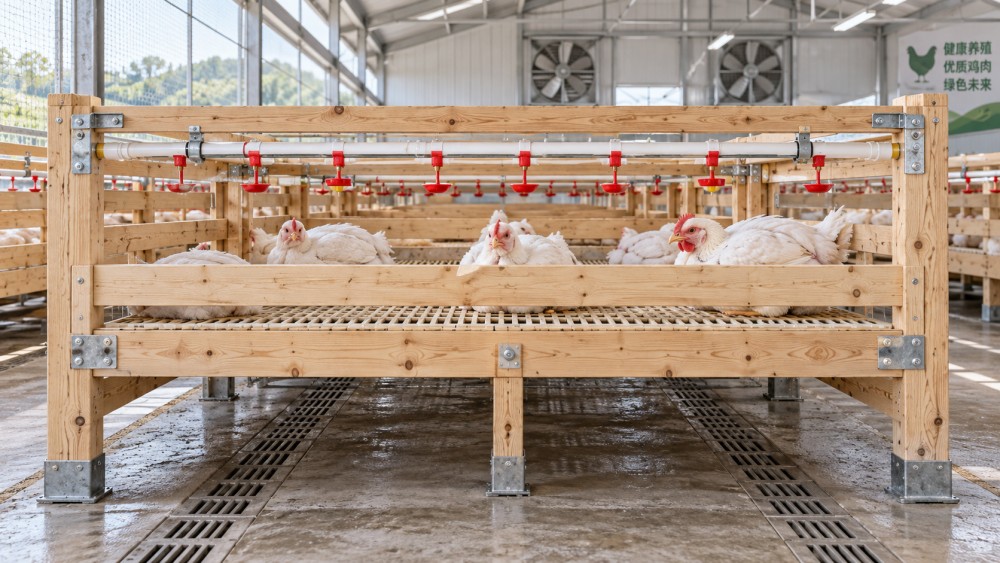
Wood absorbs and releases moisture according to surrounding conditions. When one side of a cage frame is repeatedly wetted while another remains relatively dry, the material can swell, shrink, twist, or split. Joints are especially vulnerable because water can settle in small gaps around screws, nail heads, lap joints, and support blocks.
In broiler facilities, the highest-risk areas are usually predictable:
- Below nipple drinker lines, bell drinkers, and pressure regulators;
- Along walls where condensation or roof leaks may run down structural surfaces;
- At cage legs or base rails that contact wet litter, wash water, or uneven concrete floors;
- Near service doors, where rain and mud may be carried into the house;
- At corners and underneath removable trays, where airflow and drying are limited.
Moisture itself does not always mean the cage must be removed. The maintenance concern is whether it has changed the wood’s load-bearing capacity, surface integrity, or cleanability. A board that has only superficial staining may remain structurally sound. A board that is soft under probe pressure, delaminating, deeply cracked, or visibly distorted should be assessed more carefully before birds are placed nearby.
Rot is often associated with prolonged dampness rather than a single wetting event. Repeated water exposure followed by incomplete drying can create a persistent condition in which wood fibers weaken and microbial growth becomes more likely. The U.S. Department of Agriculture Forest Products Laboratory explains that decay fungi require moisture, oxygen, suitable temperature, and a food source; controlling moisture is the most practical prevention measure in most wood-use environments. Source: USDA Forest Products Laboratory, Wood Handbook: Wood as an Engineering Material, Chapter 14, “Biodeterioration of Wood.”
That principle applies directly to poultry equipment maintenance. Replacing a rotted rail without correcting a leaking drinker line or poor drainage only postpones the next repair.
Cleaning can expose hidden weaknesses or create new ones
Cleaning is necessary between flocks, but aggressive washing can be damaging when wooden cages are not designed for sustained water saturation. High-pressure water directed into joints may force contaminants deeper into cracks and loosen fixings. It can also remove surface coatings or protective finishes that had limited water uptake. A cage may look cleaner after washing but take much longer to dry internally.
The cleaning sequence matters. Dry removal of litter, dust, feathers, and manure should come before any wet process where practical. This reduces the amount of organic material turned into slurry and limits how much water must be applied. After washing, the key maintenance question is not simply whether the surface looks clean; it is whether corners, joints, underside members, and areas beneath hardware have dried adequately.
Disinfectants also require care. Some products may be appropriate for poultry premises when used according to their label, but concentrated chemicals or unsuitable formulations can affect coatings, corrode metal fasteners, or leave residues on rough timber. The product label, local veterinary guidance, and the cage supplier’s material instructions should determine dilution, contact time, and compatibility. Maintenance personnel should avoid assuming that a disinfectant suitable for a concrete floor is equally suitable for unfinished or damaged wood.
The World Organisation for Animal Health identifies cleaning and disinfection as core biosecurity measures and emphasizes that organic matter reduces disinfectant effectiveness. Source: World Organisation for Animal Health (WOAH), Terrestrial Animal Health Code, Chapter 6.5, “Biosecurity Procedures in Poultry Production.” In a wooden cage system, that guidance has a practical implication: a rough, cracked, or absorbent surface is harder to clean consistently because soil can remain below the visible surface.
Warning signs after wash-down
Inspection is most useful after the unit has dried, not immediately after washing. Water can temporarily mask surface cracks, soften fibers, and make fasteners appear tighter than they are. Once dry, inspect for raised grain, flaking coatings, warped slats, widening joints, rusty fasteners, and uneven support members.
A simple field check is to press a blunt tool into suspect wood near the bottom edge, at joints, and below water equipment. Sound timber should resist indentation. If the probe sinks unusually easily or breaks through a surface skin into soft material, the issue is more than staining. Maintenance records should identify the exact location, likely moisture source, date of observation, and whether the defect expanded after the next cleaning cycle.
Repair decisions should start with the failure mechanism
Quick repairs can create problems when the cause of failure has not been identified. Adding a new board over a damaged rail, for example, may restore short-term stiffness but can trap moisture between materials. Driving longer screws into weakened timber may hold briefly, then split the remaining sound section. Using a metal bracket can be effective, but only if the surrounding wood can still carry the transferred load.
A practical repair assessment can separate defects into three categories:
Bird contact points deserve additional attention. A repair surface should not leave sharp screw points, exposed wire ends, protruding brackets, or rough splinters where birds or workers can be injured. The repair must also preserve usable space and prevent pinch points around doors, feeders, and access openings.
When a replacement component is fitted, its grain direction, thickness, support spacing, and connection method should match the duty of the original part. A thin board used in place of a load-bearing rail may deform even if it appears acceptable on installation day. Similarly, a replacement made from wood with very different moisture content may shrink or swell after installation, loosening fasteners or opening gaps.
Maintenance priorities in warm and humid operating conditions
In many poultry regions, maintenance teams work with variable rainfall, high ambient humidity, intermittent electricity, and water systems that are not always monitored continuously. These conditions can increase the chance that a small leak remains active for hours before it is detected. Where house ventilation is limited during wet weather, drying time after cleaning may also extend.
Selection and maintenance discussions around a broiler wooden chicken cage in nigeria should include the expected water exposure, type of drinker system, house floor condition, and availability of replacement timber or hardware. The choice should not be based only on cage dimensions or initial material appearance. A design that provides clearance from wet floors, access to water lines, replaceable wear components, and visible inspection points can reduce the difficulty of later repairs.
For existing cages, moisture control is usually more cost-effective than repeated timber replacement. Maintenance teams can check drinker height and pressure, inspect hose connections, look for blocked drainage routes, and verify that wash water does not collect beneath the cage base. If a particular location repeatedly becomes wet, the recurring pattern should be recorded. A repeated failure near one wall may indicate roof runoff or condensation; repeated damage below one drinker section points more directly to water delivery equipment.
Do not treat coatings as a substitute for drainage and drying
Protective finishes may slow moisture uptake when they are compatible with the intended poultry-house cleaning routine. They cannot compensate for standing water, persistent leakage, or wood already affected by decay. Coatings can also hide early surface changes, so inspection should include edges, drilled holes, joints, and areas where the coating has been scratched by trays or tools.
If a coating is considered after repair, the wood should be clean and adequately dry before application. Applying a finish over damp timber can trap moisture and lead to peeling or poor adhesion. The selected material should be reviewed for suitability around livestock housing and for compatibility with subsequent cleaning products. Where local requirements apply to chemical use, waste handling, or poultry housing sanitation, those requirements should take precedence.
A repeatable inspection routine reduces emergency repairs
After-sales maintenance is more effective when inspections are linked to flock turnover, cleaning cycles, and water-system checks rather than performed only after a visible breakage. A short, consistent checklist can reveal deterioration before it becomes a housing interruption.
- Walk the cage line before cleaning and mark existing cracks, loose components, or wet zones.
- During cleaning, avoid directing high-pressure water into joints unless the equipment design specifically permits it.
- After drying, inspect base rails, corners, drinker-line supports, door frames, and fasteners.
- Test suspect sections for movement, softness, and alignment under normal hand pressure.
- Correct the moisture source before installing replacement timber.
- Record the repair material, fastening method, location, and follow-up inspection date.
Records matter because recurring repairs are diagnostic evidence. If the same repair returns after every flock, the problem may be poor drainage, a poorly positioned drinker, incompatible cleaning chemistry, inadequate drying, or an underspecified component. Replacing the same board repeatedly without identifying that pattern increases labor and can gradually reduce confidence in the entire cage structure.
When replacement is safer than continued patching
A wooden cage section should be considered for replacement when deterioration affects multiple connected members, when load paths are uncertain, or when the surface can no longer be cleaned without leaving embedded debris in cracks and soft areas. Repair may still be reasonable for isolated damage, but a patch should not be used to extend service indefinitely where the surrounding frame is weakening.
The most reliable maintenance approach is preventive rather than cosmetic: keep water off the timber where possible, remove organic matter before wet cleaning, allow sufficient drying, inspect joints after each major wash, and repair the source of moisture before repairing the wood. That sequence protects the cage structure while helping maintenance teams maintain a cleaner and more predictable poultry environment.
Related News
- Moisture, Cleaning and Repair Risks in Wooden Broiler Chicken CagesOct 07, 2026Broiler wooden chicken cage in Nigeria maintenance guide: prevent moisture damage, improve cleaning, and make safer repairs for lasting poultry housing.
- What Is a Poultry Company? Core Operations From Flock Care to EquipmentOct 01, 2026que es una empresa avicola? Explore how poultry companies manage flock care, housing, equipment, biosecurity, and production for reliable operations.
- How Floor Space Allocation Affects Welfare and Productivity in a 1,000-Bird Layer HouseSep 17, 2026dimension poulailler pour 1000 poules pondeuses — discover how precise floor space allocation boosts welfare, productivity & ROI in layer houses.
- Homemade Laying Hen Cages: Materials, Dimensions, and Safety ChecksSep 07, 2026Como hacer jaulas para gallinas ponedora caseras: explore safe materials, practical dimensions, ventilation, egg hygiene, and essential checks for a reliable setup.