




Search
Related News
- 00
0000-00
When do food supply chain disruptions justify higher safety stock? - 00
0000-00
How to identify purchase drivers through consumer behavior analysis - 00
0000-00
Can rotary jet technology cut water use in beverage tank cleaning? - 00
0000-00
What limits consumer adoption in the nutrigenomics market? - 00
0000-00
Which sources provide reliable sustainable food systems market data?
Tags
Can rotary jet technology cut water use in beverage tank cleaning?




Rotary jet technology can reduce water consumption in beverage tank cleaning when stronger mechanical action removes the limiting residue and the cleaning recipe is adjusted around verified coverage. Replacing a spray device alone does not establish savings. If rinse volumes, circulation times, or sanitation stages remain unchanged, a new cleaning head may improve soil removal without reducing fresh-water demand.
The strongest application is a tank where the existing system needs prolonged spraying to remove adherent deposits. The case is weaker where residue dissolves readily, cleaning time is governed by chemical contact, or most water is consumed outside the tank. A useful assessment therefore starts with the current water balance and the hardest-to-clean surfaces, then tests whether rotary jets change those constraints.
Where the water reduction actually comes from
A rotary jet head directs concentrated streams through a controlled movement, progressively sweeping the tank interior. Compared with a static spray ball, this concentrates mechanical energy into smaller impact areas. Where those jets reach the residue with sufficient force, they can break up deposits that otherwise require longer exposure to flowing liquid or detergent.
That mechanism creates several possible routes to savings: a shorter initial rinse, less time circulating detergent, or fewer repeat cleaning cycles. These routes have different effects on fresh-water consumption. Shortening a once-through rinse directly reduces incoming water. Shortening a recirculated wash primarily reduces operating time; its water benefit depends on whether it also changes solution preparation, makeup, dumping, or subsequent rinsing.
Cleaning-head flow and total cycle water are different measurements. A device that circulates a substantial volume can still use little additional fresh water during a closed-loop wash. Conversely, a low-flow device running a long once-through rinse can consume more water overall. Compare fresh water entering the complete cleaning cycle, with recovered water recorded separately.
There is also a minimum useful operating duration. A rotary jet head needs time to complete its specified coverage pattern, and difficult deposits may require repeated passes. Cutting the cycle before that pattern finishes creates an apparent saving by leaving surfaces insufficiently exposed. The relevant target is the shortest validated cleaning cycle, including the coverage and contact time required for each stage.
Residue determines whether impact is valuable
Fresh, water-soluble beverage residues often rinse away readily. In a smooth tank with good drainage, an existing spray ball may already remove them efficiently. The remaining water demand may come from clearing detergent, flushing pipework, or meeting the established sanitation process. More force at the tank wall offers limited benefit when wall cleaning is already complete.
Dried syrup, pulp deposits, yeast films, and adherent protein-containing residues present a different problem. Concentrated jets can help detach these soils, although chemistry and temperature still determine how easily the deposits release. For protein-containing beverages, an unsuitable initial rinse temperature can make deposits harder to remove. Stronger impact does not correct an inappropriate cleaning sequence.
Mineral deposits require separate consideration. If removal depends on an acid stage, increasing mechanical force will not automatically eliminate the required chemical exposure. Likewise, visible soil removal does not establish microbial control. Cleaning must prepare surfaces for the validated sanitation stage, whose concentration, temperature, and contact conditions remain part of the acceptance criteria.
Residue condition at the start of cleaning matters as much as product type. A trial immediately after emptying can produce favorable results that do not represent tanks held dirty through a production interruption. Compare systems under the longest relevant dirty hold time and include the most difficult product formulation within the intended operating range.
Tank geometry sets the coverage limit
Jet reach must be assessed against the actual vessel. Tank diameter, height, roof shape, and cone geometry change the distance and angle between a nozzle and a surface. A stream striking a nearby wall nearly square-on behaves differently from one reaching a distant surface at a shallow angle. A nominal cleaning radius does not establish effective soil removal everywhere inside that radius.
Internal fittings create the more consequential uncertainty. Agitator blades, baffles, cooling coils, level probes, and projecting connections can shield surfaces from direct impact. A jet can strike the front of an obstruction while leaving its underside or the wall behind it poorly exposed. Liquid running over that hidden area may provide wetting without enough mechanical action to remove adherent soil.
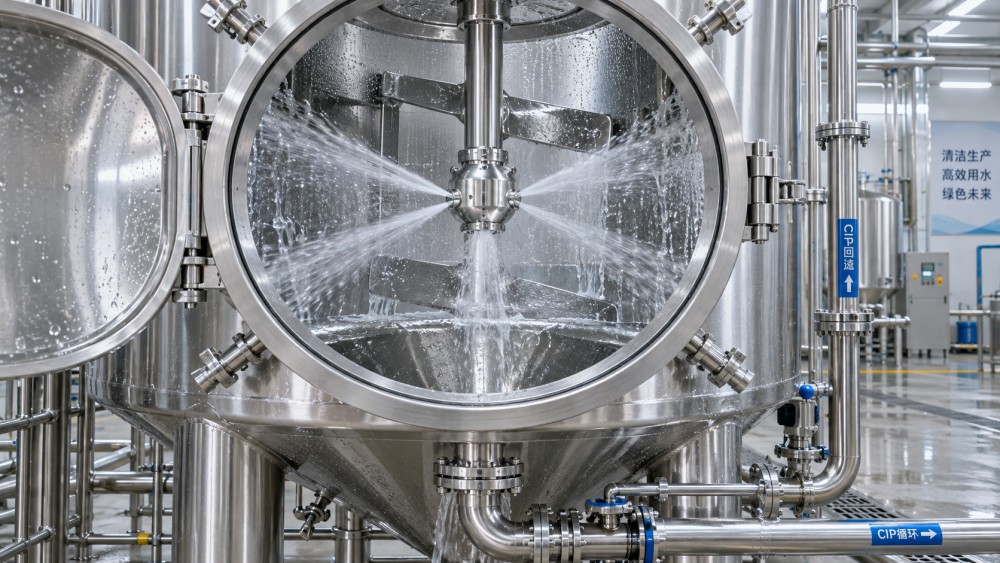
The installation drawing should connect head position and orientation with the surfaces that are most difficult to clean. For a vessel with significant obstructions, repositioning the head or adding another device may be necessary. That additional flow belongs in the water calculation. Comparing one rotary head with an existing multi-device arrangement is meaningful only if both configurations achieve acceptable cleaning across the same surfaces.
Coverage testing and residue testing answer different questions. A fluorescent coverage test can reveal areas that receive inadequate exposure, but it does not prove removal of actual beverage soil or successful sanitation. Product-specific trials must investigate the locations most likely to retain residue, including undersides, seal interfaces, and outlet transitions.
Drainage also affects performance. Pooling at the tank bottom can reduce useful jet impact, dilute cleaning chemistry, and carry residue into later stages. If the return system cannot handle the delivery rate, increasing spray flow may deepen the pool. The return pump, outlet geometry, and any strainers therefore belong in the cleaning assessment.
Read pressure, flow, and rotation together
Supply pressure is meaningful only when its measurement location is clear. Pressure at the cleaning skid differs from pressure at the head because piping, elevation, valves, and restrictions consume part of the available pressure. A proposed device should be evaluated using its inlet conditions during operation, including periods when other equipment draws from the same supply.
Higher pressure does not guarantee proportionally better cleaning. Nozzle geometry, flow, stand-off distance, and jet coherence affect the impact delivered to the wall. Excessive adjustment can also place the device outside its specified operating range. The useful comparison combines the manufacturer’s operating data with the installed hydraulic conditions and observed cleaning results.
For fluid-driven rotary heads, pressure and flow also influence movement and pattern timing. Insufficient supply can produce slow or irregular rotation, leaving the scheduled cycle too short for full coverage. A flow reading alone cannot confirm correct movement: liquid can still pass through a device that has stalled. Where coverage depends on rotation, a suitable means of verifying movement adds evidence beyond pump status.
Changes to nozzle size need similar scrutiny. Smaller openings can reduce instantaneous flow, but they also change hydraulic demand and cleaning performance. If the resulting cycle needs extra pattern passes or longer rinsing, the expected saving can disappear.
Build the comparison around a stable baseline
A defensible trial begins with the existing system operating correctly. Blocked spray holes, inadequate pressure, or a faulty return pump can make the baseline unnecessarily wasteful. Comparing a new head against a degraded installation exaggerates the value of the technology change and obscures improvements achievable through maintenance.
Record water by stage: initial rinse, detergent preparation and makeup, intermediate rinses, final rinse, and any water-consuming sanitation step. Include associated line flushing where it forms part of the measured cleaning scope. Keep that scope identical across trials. Otherwise, moving consumption outside the measurement boundary can look like a reduction.
First establish that the rotary jet arrangement achieves acceptable results using a conservative recipe. Then reduce the stages that its stronger mechanical action plausibly affects, changing one relevant variable at a time. Shortening the initial rinse while simultaneously changing detergent concentration and wash temperature makes the source of any improvement difficult to identify.
Rinse endpoints need particular care. Return conductivity can help identify detergent clearance when it has been validated for the chemistry and water involved. It does not independently prove removal of every organic residue. Sample timing and location must also account for mixing and transport delay; a clean return sample can overlook retained liquid in a poorly drained pocket.
Acceptance should combine the established residue and hygiene criteria with measured water consumption. Visual examination, appropriate residue testing, and microbiological verification each have a defined role. Rapid hygiene indicators require interpretation within the validated program rather than being treated as universal proof of sanitation. Include repeat-clean events in the comparison: a shorter nominal cycle loses value if incomplete cleaning regularly triggers another run.
Integration can preserve or erase the saving
Rotary equipment introduces moving components whose condition affects the cleaning pattern. Bearings, gears, seals, and nozzles require maintenance appropriate to the device design. Deposits or debris can obstruct movement or change jet behavior. Any strainers added to protect the head need suitable cleaning access and enough capacity to avoid starving the device.
The head itself must be cleanable, compatible with the beverage process, and suitable for the cleaning chemicals and temperatures. Mounting connections, external surfaces, and internal passages deserve attention alongside wall coverage. A device that cleans the vessel effectively but retains product in an inaccessible feature creates a separate hygiene problem.
Existing pumps and controls may need modification to maintain the specified inlet conditions. Additional heads can increase flow demand; higher pressure can increase pumping energy. Include these changes, inspection access, and maintenance effort when comparing operating cost. Water savings remain valuable, but their financial effect depends on local water supply, wastewater handling, heating, and chemical use.
The clearest selection evidence is an installed trial showing lower fresh-water input across representative difficult cleaning conditions, with acceptable coverage, residue removal, and sanitation results. If the reduction appears only on easy products, requires marginal operating pressure, or relies on stopping before full coverage, the proposed recipe has not yet demonstrated a reliable advantage. Where those conditions are resolved, rotary jet technology offers a credible route to lower water use through a shorter, verified cleaning process.
Related News
- Can rotary jet technology cut water use in beverage tank cleaning?Oct 15, 2026Discover how beverage tank cleaning technology with rotary jets can reduce water use through verified coverage and optimized cycles without compromising hygiene.
- Control System Design Priorities for Ingredient Manufacturers Handling Allergen RisksOct 12, 2026Ingredient manufacturers controls design: explore practical priorities for allergen-safe routing, cleaning verification, traceability, and production control systems.
- Investigating Foaming, Sediment, and Uneven Blending in Beverage TanksOct 12, 2026Beverage tanks troubleshooting guide: identify foam, sediment, and uneven blending causes, improve mixing consistency, reduce waste, and support reliable beverage production.
- How quality assurance in bioprocessing prevents batch-to-batch variabilityOct 05, 2026Quality assurance in bioprocessing reduces batch-to-batch variability through proactive controls, real-time monitoring, change management, and reliable process consistency.