




Search
Related News
- 00
0000-00
How to verify supplier production capacity in Southeast Asia - 00
0000-00
When should you hire an industrial project solutions contractor? - 00
0000-00
What to look for in wearable pet health technology for early illness alerts - 00
0000-00
How hygienic process control prevents cross-contamination between batches - 00
0000-00
Where does the hygienic process industry face its highest contamination risk?
Tags
How hygienic process control prevents cross-contamination between batches




Cross-contamination between batches rarely begins with one obvious sanitation failure. More often, it develops through a chain of smaller control gaps: residue left in a valve pocket, an incorrectly reassembled gasket, an unlabelled intermediate container, a shared hose returned to service before release, or a changeover completed without confirming that the previous product has actually been removed.
Hygienic process control prevents these failures by treating batch separation as a controlled system rather than a cleaning task. Equipment design, material routing, cleaning parameters, line clearance, personnel movement, environmental conditions, and records must all support the same outcome: no unintended carryover of product, allergen, microorganism, chemical residue, packaging material, or process aid from one batch into the next.
Batch separation starts before cleaning begins
A batch is not fully separated merely because production has stopped and a wash cycle has started. Separation begins when the last acceptable unit of the previous batch leaves the process and continues until the next batch is verified for release. This interval includes removal of residual material, identification of exposed parts, cleaning and drying, inspection, line clearance, assembly, and confirmation that the correct materials are connected for the next run.
The risk profile differs by process. In dry powder handling, retained dust in filters, screw conveyors, bagging heads, and extraction ducts can migrate into the next formulation. In liquid processing, dead legs, low points, flexible hoses, valve cavities, pump housings, and poorly drained pipework can retain product or cleaning solution. In life-science operations, the concern may include biological carryover, active ingredients, culture residues, or cleaning-agent residues. In food production, allergens and microbial hazards may be the dominant concern, while animal-feed or agricultural input lines may need to control ingredient carryover and chemical residues.
The practical question is not whether a line has been cleaned, but whether every location capable of retaining or transferring the previous batch has been identified and brought under control.
Residue retention is the physical basis of many failures
Cross-contamination requires a transfer pathway. Hygienic process control works by eliminating, reducing, or verifying those pathways. The first pathway is retained residue. Product can remain where flow is slow, where surfaces are rough or damaged, where equipment cannot drain, or where an assembly creates hidden gaps.
Common retention points include:
- gaskets, O-rings, clamp connections, and valve seats;
- dead-end branches and pipe sections that are not adequately swept during cleaning;
- hoses stored with residual moisture or product inside;
- screens, filters, strainers, and product-contact instruments;
- pump casings, sampling ports, filler nozzles, and dosing heads;
- threads, damaged welds, cracked seals, and worn conveyor components;
- dust collection systems and inaccessible surfaces around open product handling points.
A visually clean surface does not necessarily indicate a hygienically clean surface. Dry powders can remain inside enclosed equipment despite clean external surfaces. Protein, fat, sugar, starch, and biofilm-forming residues may remain in areas that are difficult to inspect directly. Conversely, a cleaning process that reaches all surfaces can still fail if its chemistry, temperature, flow conditions, contact time, or rinse sequence is not suitable for the soil present.
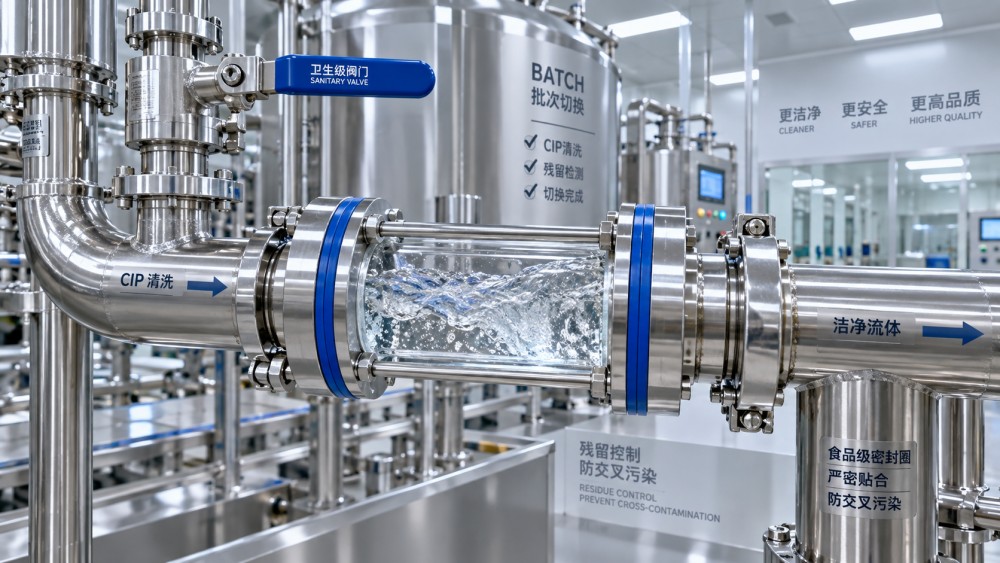
Equipment geometry matters because cleaning is a mechanical and chemical process, not simply an exposure to water or detergent. Clean-in-place systems depend on validated flow paths and sufficient turbulence where required. Clean-out-of-place procedures depend on disassembly instructions that expose all product-contact surfaces. If an operator cannot access, inspect, drain, or correctly reassemble a component, the process has a control weakness regardless of how detailed the sanitation instruction appears.
Cleaning parameters must match the residue and the equipment
A sanitation procedure should specify more than a product name and a wash duration. It needs operating limits that can be checked: concentration or conductivity where applicable, temperature, circulation time, flow rate or pressure where relevant, rinse quality, and the required sequence of steps. These conditions should be linked to the actual residue and the line design.
For example, an alkaline cleaner may be suitable for many organic soils, but its effectiveness depends on temperature, concentration, contact time, and the ability of the cleaning solution to contact the contaminated surface. Mineral scale may require an acid cleaning stage. Fatty or highly adhesive products may need a different pre-rinse approach from starch-rich products. A high-temperature cycle is not automatically better if heat sets a residue onto surfaces or exceeds gasket, hose, or instrument limits.
Water quality also deserves attention. Hard water can affect detergent performance and leave deposits. Inadequate final rinsing can create chemical carryover into the next batch. Where rinse water is reused or recovered, its intended application and hygiene status must be controlled; recovered water should not be assumed suitable for final product-contact rinsing without an established basis.
Cleaning instructions should state what must be dismantled, what may remain assembled, which parts require manual attention, and how parts are to be protected after cleaning. A procedure that depends on operator judgment without clear criteria creates variability precisely where batch separation needs consistency.
Changeover is a release process, not a production interruption
Changeovers are often vulnerable because they involve time pressure, material movement, equipment adjustment, and handoffs between shifts. The strongest control is to define the changeover as a release process with observable acceptance conditions.
Line clearance should confirm that the previous batch has been removed not only from the main processing equipment, but also from local storage points: containers, scoops, labels, coding devices, printers, staging racks, reject bins, weigh stations, sampling tools, and electronic production settings. The next batch can be compromised by the wrong packaging or label even when the product itself is microbiologically and chemically acceptable.
Particular attention is needed where allergen-containing and non-allergen products share equipment. The cleaning standard must reflect the hazard being controlled. A routine visual inspection may be useful for gross residue, but it is not sufficient evidence that an allergen has been removed. Verification methods should be appropriate to the material, surface, and risk. Depending on the operation, these may include visual inspection, protein or allergen-specific tests, ATP testing as a general hygiene indicator, swab testing, rinse sampling, conductivity checks, or microbiological sampling.
Each method has limits. ATP testing detects biological residues but does not identify a specific allergen and does not establish that a surface is free of all relevant hazards. A negative result from a poorly selected swab location provides limited assurance. Rinse tests may indicate the condition of accessible flow paths while missing a poorly drained component. Verification should therefore focus on the points most likely to retain material, not merely on the easiest places to test.
Validation, verification, and monitoring answer different questions
These terms are often used interchangeably, but they serve different control functions.
Validation establishes that a defined cleaning or changeover method is capable of achieving the required standard under specified conditions. It considers the worst credible case: difficult-to-clean product characteristics, hard-to-reach equipment areas, maximum permitted hold time before cleaning, and the relevant hazard. A validated procedure cannot simply be transferred to a different product, line configuration, or soil condition without assessing whether the original basis still applies.
Verification confirms that the validated procedure was carried out effectively on a particular occasion. It may include pre-operational inspection, documented cleaning-cycle parameters, swabs, rinse checks, or inspection of dismantled parts. Verification provides evidence that the line is ready for the next batch.
Monitoring is the routine observation of conditions that must remain within control, such as detergent concentration, wash temperature, flow, time, filter condition, or differential pressure. Monitoring can show that the process followed its set parameters, but it does not replace verification of cleanliness.
This distinction is important during deviations. If a wash cycle falls below its required temperature, the concern is not resolved by extending a signature on the sanitation record. The deviation must be assessed against the validated limits. The line may require re-cleaning, additional verification, or an investigation into the heating, circulation, dosing, or sensor system.
Material flow can defeat an otherwise clean line
Even a well-cleaned process line can be recontaminated by poor movement of people, tools, materials, or waste. Hygienic zoning separates activities with different hygiene requirements and prevents uncontrolled movement from lower-control areas to exposed product areas.
Zones should reflect the real process rather than a generic site map. An enclosed raw-material warehouse does not present the same risks as an open filling area. A utensil wash station may be clean in appearance but can become a transfer point if cleaned tools are stored beside unwashed equipment. Maintenance activity can introduce lubricants, metal fragments, tools, dust, or microorganisms unless work is controlled and the affected area is cleared before restart.
Colour coding can support separation of utensils and cleaning tools, but colour alone is not a control system. Tools need a defined ownership, storage point, cleaning status, and replacement process. A brush assigned to one zone is ineffective if it can be moved freely between zones or stored wet and contaminated. Similar discipline is needed for portable hoses, vacuum equipment, sampling devices, pallets, mobile bins, and reusable protective garments.
Where shared equipment cannot be avoided, production sequencing may reduce risk. A sequence based on allergen status, microbiological sensitivity, ingredient intensity, or cleaning difficulty can reduce the number of high-risk changeovers. Sequencing is not a substitute for cleaning, but it can make the control strategy more resilient when the next product would be particularly vulnerable to carryover.
People are part of the hygienic design
Operators are often the only people who can detect a loose gasket, an abnormal odour, a blocked spray device, a missing seal, unexpected residue, or an incorrectly connected hose before the next batch begins. These observations have value only when the process makes it safe and practical to act on them.
Instructions should use clear equipment-specific language. “Clean thoroughly” is not an acceptable operational criterion. A usable instruction identifies the component, the required action, the cleaning method, the inspection point, the acceptable condition, and the required response if the condition is not met. Photos or diagrams can help with complex assemblies, but they should show the current equipment configuration and be controlled when equipment changes.
Assembly errors deserve the same attention as cleaning errors. A gasket placed incorrectly can create a crevice, leak path, or dead space. A valve body assembled in the wrong orientation can prevent drainage or cleaning solution coverage. Where components are similar, identification marks and assembly checks reduce reliance on memory. For critical assemblies, a second-person check may be justified when the risk of error cannot be adequately controlled by design or automation.
Hand hygiene, glove use, and protective clothing matter most at points where product or product-contact surfaces are exposed. Gloves are not inherently hygienic; they can transfer contaminants if worn across incompatible tasks. The control is task separation and replacement when gloves become contaminated, damaged, or unsuitable for the next activity.
Records must make the batch boundary visible
Traceable records turn hygienic process control into evidence. They should make it possible to establish which product ran previously, which equipment and utensils were used, what cleaning method was applied, whether required parameters were achieved, who performed and verified the work, and whether any deviation occurred.
Electronic systems can improve legibility and prevent incomplete entries, but paper and electronic records have the same underlying requirement: entries must reflect what actually happened. A completed checklist is weak evidence if it contains only routine signatures and no link to measurable conditions or inspection results.
Batch records should also capture exceptions. If a hose was replaced, a valve was opened for repair, a wash cycle was interrupted, a cleaning chemical was changed, or a pre-operational inspection found residue, that information affects the confidence of the release decision. Recording the correction is as important as recording the original failure, because it demonstrates how the batch boundary was restored.
Standards provide a framework, but control limits remain site-specific
Food safety management systems commonly draw on hazard analysis principles and prerequisite programmes for sanitation, personnel hygiene, pest control, maintenance, water quality, and traceability. ISO 22000 provides a framework for food safety management systems, while Codex General Principles of Food Hygiene set internationally recognized hygiene principles. In regulated life-science settings, applicable Good Manufacturing Practice requirements may impose more detailed expectations for cleaning, documentation, contamination control, and change control.
These frameworks do not eliminate the need for process-specific decisions. A standard cannot determine the right swab location, rinse volume, wash temperature, or acceptable residue limit without considering the product, hazard, equipment, cleaning chemistry, and intended use. The most reliable controls are those that translate general hygiene requirements into defined, observable conditions at the actual point of operation.
Effective batch separation is therefore not measured by how often sanitation is performed. It is measured by whether the process can consistently prevent carryover, reveal when a control has failed, and stop the next batch from starting until the boundary is restored. That is the practical purpose of hygienic process control: making cleanliness, separation, and release verifiable rather than assumed.
Related News
- When should you hire an industrial project solutions contractor?Sep 18, 2026Industrial project solutions contractor: discover when complex scopes, site risks, and shutdown constraints require coordinated delivery for safer, smoother project success.
- How hygienic process control prevents cross-contamination between batchesSep 19, 2026Hygienic process control prevents cross-contamination between batches through validated cleaning, line clearance, and traceable release steps. Explore practical safeguards.
- Where does the hygienic process industry face its highest contamination risk?Sep 19, 2026Hygienic process industry contamination risk is highest after final control steps. Explore critical zones, hidden hazards, and practical prevention strategies.
- Why Stainless Steel Beverage Tanks Affect Cleaning and Product QualitySep 08, 2026Beverage tanks influence cleaning reliability and product quality. Discover how stainless steel grade, surface finish, drainage, and mixing design reduce contamination risks.