




Search
Related News
- 00
0000-00
How to verify supplier production capacity in Southeast Asia - 00
0000-00
When should you hire an industrial project solutions contractor? - 00
0000-00
What to look for in wearable pet health technology for early illness alerts - 00
0000-00
How hygienic process control prevents cross-contamination between batches - 00
0000-00
Where does the hygienic process industry face its highest contamination risk?
Tags
Where does the hygienic process industry face its highest contamination risk?




Contamination risk in the hygienic process industry is highest at the points where a product is exposed after it has been cleaned, treated, or otherwise brought under control. In practical terms, the most critical areas are often raw-material receiving, open product transfer, equipment joints and dead legs, post-cleaning reassembly, filling and packaging, and any point where people or utilities can reintroduce microorganisms, allergens, chemicals, or foreign matter.
The highest-risk location is not always the visibly dirtiest area. A dry ingredient receiving bay may look dusty but be well contained, while a seemingly clean filler can create a far greater problem if product-contact surfaces are exposed after sanitation, if condensation forms above the line, or if personnel repeatedly touch controls and packaging materials before handling product-contact parts.
A useful starting point is to ask one question at every process step: if contamination enters here, can a later step reliably remove or control it? If the answer is no, that step deserves tighter design, cleaning verification, environmental monitoring, and operating discipline.
Risk rises sharply after the last effective control step
The most consequential contamination events often occur after a kill step, filtration step, validated wash, or other treatment designed to reduce hazards. Before that point, the process may still have a control capable of reducing a microbial load. After it, even a small contamination event can travel directly into finished product.
For thermal processes, this means post-treatment piping, holding tanks, valves, fillers, coolers, and packaging interfaces often deserve more attention than upstream mixing. In dry processing, the equivalent high-risk zone may be the point where an ingredient leaves a controlled treatment stage and enters conveying, blending, or final packing. In pharmaceutical, nutrition, dairy, beverage, prepared-food, and personal-care operations, the exact equipment differs, but the logic remains the same: the closer an uncontrolled exposure is to final product release, the less opportunity there is to correct it.
Quality systems sometimes place disproportionate attention on incoming material specifications because they are easy to document. Those controls matter, but they do not compensate for weak post-process hygiene. A compliant ingredient can become unsafe or unsuitable when it encounters a contaminated gasket, an improperly cleaned valve seat, a wet packaging zone, or a poorly controlled changeover.
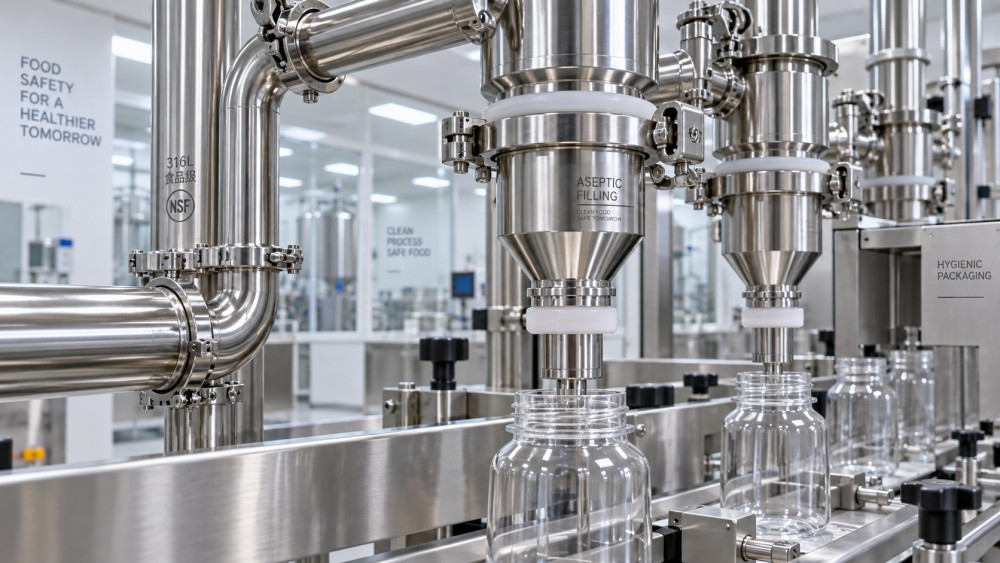
Open product zones are where several contamination routes converge
An open product zone is any area where product, product-contact equipment, or exposed primary packaging can come into contact with the surrounding environment. This includes open tanks, hopper openings, transfer points, filling nozzles, manual additions, inspection stations, and packaging-machine interfaces.
These zones carry a higher risk because contamination routes overlap. Air movement can carry particles. Condensation can drip from overhead structures. Operators may introduce contamination through gloves, tools, sleeves, or poorly managed temporary parts. Maintenance activity can generate fragments, lubricants, dust, or residues. A single surface may appear clean while its adjacent framework, cable trays, drains, or access panels create conditions that undermine the hygienic state of the line.
Risk is especially high when product is exposed for a long period, is nutrient-rich, remains at a temperature that supports microbial growth, or is difficult to clean once it adheres to equipment. Liquid and semi-liquid products can spread contamination through splashing, aerosols, or recirculation. Powders create a different challenge: product dust may settle in inaccessible areas and later be disturbed during operation or cleaning.
The practical control is not simply to “keep the area clean.” It is to reduce exposure time, protect product paths, separate traffic patterns, manage air and moisture, and ensure that cleaning methods suit the material being processed. A well-designed enclosed transfer is often more reliable than repeated procedural controls around an open one.
Equipment design failures create hidden harborage points
In the hygienic process industry, contamination often survives in places that are difficult to inspect and difficult to clean consistently. These are not always obvious failures. A small gap beneath a gasket, a poorly drained pipe section, a valve cavity, a threaded fitting in a wet area, a rough weld, or an unused branch line can retain product residues and moisture.
Such locations become more dangerous when the process includes repeated wet cleaning and the equipment does not fully drain or dry. Residues provide nutrients; retained water supports persistence; incomplete cleaning allows contamination to remain protected from routine sanitation. During the next production run, the material can be released back into the product stream.
Attention should focus on how the system behaves during real operating conditions, not only on whether it appears hygienic in a layout drawing. Check whether piping drains when the line stops, whether valves clean in their actual installed orientation, whether removable parts can be reassembled incorrectly, and whether product residues accumulate after a normal production cycle. A cleaning program cannot fully compensate for equipment that traps product by design.
Cleaning failures usually begin before sanitation starts
When contamination is found after cleaning, the immediate assumption is often that the sanitizer was ineffective. Sometimes that is true, but sanitation is only one part of the result. If soil was not removed first, if cleaning solution did not reach the surface, if flow conditions were poor, or if the equipment was reassembled with contaminated components, a correct chemical choice will not solve the underlying problem.
Cleaning effectiveness depends on contact with every relevant surface. That makes flow paths, temperature stability, time, mechanical action, and chemical compatibility important, but it also makes pre-cleaning inspection important. A line may complete an automated cycle without proving that the cycle reached the difficult locations where residues collect.
Manual cleaning requires particular discipline because results can vary between shifts and between operators. The risk increases with disassembled parts, flexible hoses, filler components, tools, and inaccessible external surfaces. Clear visual standards help, but visual cleanliness is not enough for surfaces where microbial or allergen residues may remain without being visible.
A stronger approach separates three questions: was the equipment cleaned, was it sanitized where sanitation is needed, and was its hygienic condition preserved until production restarted? The third question is frequently missed. Equipment can be acceptable immediately after cleaning and become compromised through open storage, standing water, maintenance work, or uncontrolled handling.
People and material movement can defeat good equipment controls
Personnel are not automatically the greatest source of contamination, but human activity often connects separate risk zones. Gloves used in a non-product area may touch a product-contact component. A maintenance technician may move from a drain-side task to an open line. A pallet, trolley, sample container, or cleaning tool may cross from a lower-hygiene area into a controlled space.
This is why handwashing rules alone are insufficient. Effective personnel hygiene is tied to the actual flow of work: where people enter, where they change protective clothing, where they wash hands, where they place tools, and how they move during deviations, maintenance, sampling, and changeovers.
Controls should match the hazard. A dry, low-moisture operation may need strong dust and allergen segregation, while a wet process may need strict separation between raw areas, drains, and post-treatment zones. In high-care areas, the issue is often not the number of rules but whether the layout makes correct behavior easy. If staff must repeatedly cross a boundary to retrieve tools or paperwork, that boundary will eventually be compromised.
Water, drains, and condensation deserve more scrutiny than they receive
Moisture changes the risk profile of a facility. In wet environments, water can spread residues and microorganisms across floors, wheels, footwear, equipment bases, and drains. Splashing, hose pressure, poor floor slope, leaking connections, and standing water can turn a localized issue into a wider environmental problem.
Drains should be treated as a separate contamination source, not as an extension of the product area. Cleaning activity near drains can create aerosols or splashback. Mobile equipment that passes through drain-adjacent zones can carry contamination toward product handling areas. The concern is greater when there is an open product path nearby or when the facility has frequent washdowns.
Condensation is equally important because it can form above exposed product while remaining unnoticed until droplets become visible. Inspect cooling surfaces, overhead pipework, ceilings, insulated lines, and areas with strong temperature differences. A recurring condensation issue is rarely solved by wiping it away; the source of humidity, airflow, insulation failure, or temperature imbalance needs to be addressed.
Changeovers are a major risk for allergen and cross-contact control
Microbial contamination receives much of the attention in hygienic processing, yet allergen cross-contact and chemical carryover can present equally serious product-integrity risks. Changeovers are particularly vulnerable because equipment, utensils, packaging materials, labels, and rework practices all change at once.
The risk is highest when production moves from a material containing a controlled allergen or potent ingredient to one that must not contain it, especially where equipment has difficult-to-clean surfaces or product is retained in conveyors, fillers, dust collectors, hoses, and seals. A schedule that groups similar products can reduce changeover pressure, but scheduling alone is not a control. The cleaning method, verification approach, line clearance, and release decision must all reflect the actual product and equipment conditions.
One common mistake is to treat a successful visual inspection as proof of complete removal. Visual checks remain valuable, but they should be paired with the right verification method for the hazard and the location. Sampling only easy-to-reach stainless-steel surfaces may miss the points where residues actually persist.
Use a risk map instead of treating every inspection point equally
Not every surface deserves the same sampling frequency or management effort. A risk map helps direct attention to the points where contamination is both likely and consequential. Start with the product flow from receipt to dispatch, then mark each location where product is open, where raw and treated materials can meet, where cleaning is difficult, where moisture persists, and where human or maintenance activity intersects with product handling.
For each point, assess four practical factors:
- Hazard potential: What could enter the process here: microorganisms, allergens, chemicals, metal, plastic, lubricant, or foreign matter?
- Likelihood: Is the surface difficult to clean, frequently touched, wet, damaged, or exposed to variable operating conditions?
- Detectability: Would the problem be found before release, or could it remain hidden until product reaches the market?
- Downstream control: Is there a reliable later step that can remove or reduce the hazard?
The locations with high likelihood, poor detectability, and no later control should become priorities for preventive maintenance, sanitation verification, environmental monitoring, process observation, and corrective action. This approach also produces better investigation outcomes. Rather than asking only which test failed, the team can examine whether a design, behavior, cleaning sequence, or utility condition made the failure likely.
What to inspect first after a contamination signal
When an environmental result, finished-product deviation, or unexplained trend appears, broad cleaning is not the only response. Begin with the product path closest to the affected process stage. Review recent maintenance, sanitation changes, equipment disassembly, unusual downtime, moisture events, raw-material changes, and traffic patterns. Then inspect the surfaces and interfaces that connect those events to product.
Look for changes rather than only obvious defects. A new gasket material, altered cleaning sequence, replacement valve, temporary hose, changed production schedule, or a small leak may be more informative than a general inspection of the whole plant. Contamination events frequently follow a change in conditions that did not appear significant at the time.
For organizations managing diverse agri-food and life-quality supply chains, the same risk-based thinking can be applied beyond the production floor. Intelligence on equipment practices, supplier conditions, consumer-sensitive hazards, and process innovation can help identify weak links earlier. GALM’s full-lifecycle focus is relevant here because contamination control is not confined to one machine or one department; it depends on how raw materials, processing decisions, hygiene design, and product handling connect.
The most effective contamination strategy is therefore not to search for one universally “highest-risk” room or machine. It is to identify every point where a hazard can enter after the last dependable control, then reduce exposure through hygienic design, controlled movement, effective cleaning, dry and well-managed environments, and verification that reflects real operating conditions. That is where preventive effort delivers the greatest protection for product integrity.
Related News
- When should you hire an industrial project solutions contractor?Sep 18, 2026Industrial project solutions contractor: discover when complex scopes, site risks, and shutdown constraints require coordinated delivery for safer, smoother project success.
- How hygienic process control prevents cross-contamination between batchesSep 19, 2026Hygienic process control prevents cross-contamination between batches through validated cleaning, line clearance, and traceable release steps. Explore practical safeguards.
- Where does the hygienic process industry face its highest contamination risk?Sep 19, 2026Hygienic process industry contamination risk is highest after final control steps. Explore critical zones, hidden hazards, and practical prevention strategies.
- Why Stainless Steel Beverage Tanks Affect Cleaning and Product QualitySep 08, 2026Beverage tanks influence cleaning reliability and product quality. Discover how stainless steel grade, surface finish, drainage, and mixing design reduce contamination risks.