




Search
Related News
- 00
0000-00
Can an Agricultural Trade Insights dashboard flag supply risks early? - 00
0000-00
Is Precision Nutrition North America right for a personalized diet plan? - 00
0000-00
How to build a technology evaluation framework for farm automation - 00
0000-00
How agri-tech forecasting data can improve planting decisions - 00
0000-00
What the Global Nutrition Trends dashboard reveals about supplement demand
What Should You Check Before Buying Used Food Processing Machinery?




A used food processing machine should be treated as a production asset with a history, not as a discounted version of new equipment. Its visible condition matters, but the more expensive problems are often hidden in product-contact surfaces, controls, seals, gearboxes, utilities, and missing documentation. Start by defining the exact product, throughput, cleaning method, and operating environment the machine must serve. A well-kept unit designed for a different process can still become a poor purchase after installation.
Before discussing price, ask for the machine's model, serial number, manufacturing date where available, original technical specification, wiring diagrams, operating manual, and maintenance history. These records establish whether the equipment can be identified, supported, inspected, and integrated. A machine without a serial plate or traceable history deserves extra scrutiny, especially where food-contact materials, electrical safety, or hygienic design must be demonstrated.
Begin with the process, not the machine category
"Food processing machinery" covers equipment with very different wear patterns and hygiene demands. A ribbon blender used for dry seasoning faces different concerns from a vacuum tumbler handling marinated meat, a depositor processing viscous fillings, or a plate heat exchanger used with dairy liquids. The intended product determines what surfaces, seals, temperatures, pressure conditions, and cleaning routines are acceptable.
Write down the actual process conditions before inspection: product acidity, salt or sugar content, particulate size, viscosity, moisture level, target batch size, inlet and outlet temperatures, cleaning chemicals, and expected operating hours. These details reveal whether apparent suitability is real. For example, a pump that moved low-viscosity oil may struggle with cold fruit puree. A mixer used on dry powder may have no evidence that its shaft seal can withstand wet cleaning. Equipment used with chloride-rich ingredients deserves close attention to corrosion in weld zones and enclosed areas.
Capacity claims also need context. A machine rated for a certain hourly output may have achieved that figure with a free-flowing product, a short cycle, and ideal feeding conditions. Ask how the output was measured and whether it includes loading, heating, cooling, cleaning, changeovers, or discharge time. A line that meets the nominal throughput only under continuous operation may not fit a batch process with frequent recipe changes.
Inspect food-contact construction and cleanability
Food safety begins with the physical condition of the product path. Identify every surface that touches ingredients, intermediate product, processing water, compressed air, or cleaning fluid. Stainless steel is common, but the grade, finish, welding quality, and condition are more informative than the generic material label.
Look inside hoppers, bowls, pipelines, valves, augers, nozzles, pumps, and discharge chutes rather than relying on exterior photographs. Pitting corrosion, deep scratches, crevices, flaking coatings, repaired cracks, and rough welds can retain residues and complicate sanitation. Discoloration alone is not proof of failure, but it should prompt questions about prior products, cleaning chemistry, overheating, and repair work. Corrosion around fasteners, gasket seats, drain points, and weld heat-affected zones may indicate repeated exposure to incompatible chemicals or moisture.
Assess whether the equipment drains fully in its installed position. Standing liquid in a low point, dead leg, pump housing, hose connection, or jacket can support contamination and create difficult cleaning validation. Covers and guards should be removable without dismantling unrelated mechanisms. Product zones should be accessible enough for visual inspection, manual cleaning where required, or a properly designed clean-in-place circuit.
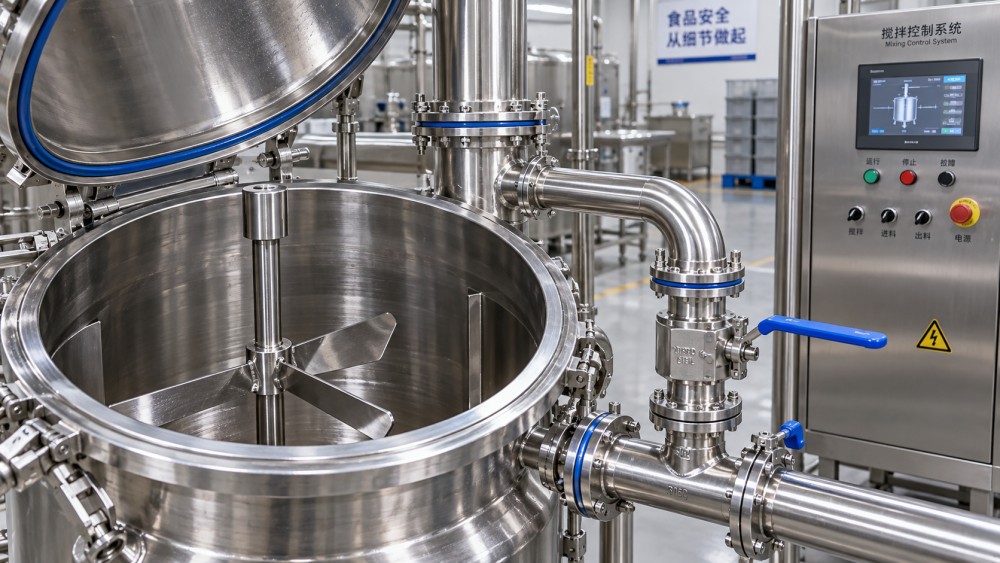
Do not assume that a clean exterior means a sanitary interior. Fresh paint, polished panels, and new labels can conceal poor conditions beneath guards or inside pipework. Conversely, cosmetic wear on a frame may be less important than intact, smooth, traceable product-contact surfaces. The inspection should distinguish between these two conditions.
Pay close attention to seals, hoses, and soft components
Elastomer parts are consumable items, even when they look serviceable. Inspect door gaskets, pump seals, valve diaphragms, flexible hoses, scraper blades, belts, and O-rings for swelling, cracks, hardening, flattened profiles, staining, or product buildup. Their compatibility depends on both the food product and the cleaning regime. A seal suitable for water-based processing may deteriorate quickly when exposed to fats, oils, solvents, high heat, or aggressive sanitation chemicals.
Ask whether replacement parts are standard items or proprietary components. A used machine with worn seals can be restored economically when correct parts remain available. The same machine becomes a larger risk when seal dimensions, material specifications, or valve internals cannot be sourced with confidence.
See the equipment operate under a meaningful load
A static inspection cannot reveal all failures. Request a live demonstration using a product that approximates the intended material, or at least a load condition that exercises the mechanical and control systems. Water is useful for checking leaks and flow, but it does not test a grinder, mixer, filler, extruder, depositor, or conveyor in the same way as a viscous, abrasive, sticky, fibrous, or particulate product.
During operation, listen for irregular bearing noise, gearbox whine, rattling guards, belt slip, unstable motor speed, and repeated actuator movement. Watch for excessive vibration, shaft runout, inconsistent filling, poor mixing circulation, temperature overshoot, pressure fluctuation, or delayed sensor response. A machine that starts smoothly when empty can behave differently after the product load rises or the process temperature changes.
Check the condition of drives and moving assemblies. Inspect chains, sprockets, belts, couplings, bearings, lubrication points, gear reducers, and motor mounts. Oil leaks near gearboxes or shafts should be traced rather than dismissed as routine maintenance. Metallic debris in lubricant, unusual heat after a short run, or a need for frequent adjustment can indicate wear beyond a simple service task.
For cutting, grinding, slicing, and milling equipment, examine the cutting set and its alignment. Dull blades are expected wear items; damaged housings, distorted shafts, loose retainers, or inconsistent blade clearance are more consequential. Inaccurate alignment can create uneven particle size, excess product heating, metal contamination risk, and accelerated wear.
Read the maintenance record for patterns
Maintenance logs are valuable when they show dates, parts replaced, recurring faults, lubrication routines, calibration work, and service providers. The goal is not to find a machine with no repairs. A machine that has operated for years without any documented attention is less reassuring than one with clear records of ordinary preventive work.
Repeated replacement of the same bearing, seal, relay, motor, or valve deserves investigation. The replaced part may be the symptom rather than the source. Recurrent seal failure, for instance, could result from shaft wear, pressure spikes, improper assembly, incompatible cleaning agents, or operation outside the pump's design range. A history of electrical faults may reflect a damp washdown environment, damaged cable routing, unstable power supply, or an aging control cabinet.
Ask which parts were changed most recently and why. Then inspect the related assemblies. An apparently new motor on a conveyor is not automatically positive if the conveyor frame is misaligned, the drive roller is worn, or the belt tension is excessive. Repair invoices, photographs, and service notes can clarify whether a repair restored the original design condition or merely kept the equipment running temporarily.
Verify controls, sensors, and electrical compatibility
The control system often determines whether older machinery remains practical. Confirm the available power supply, voltage, frequency, phase, earthing arrangement, and motor ratings against the installation site. Electrical conversion is possible in some cases, but changing supply characteristics can affect motors, drives, heaters, transformers, control components, and safety circuits. It should be assessed as an engineering scope, not treated as a minor adapter issue.
Open the control panel where safe and permitted. Look for heat damage, corrosion, loose terminals, unlabelled wiring, obsolete components, bypassed safety devices, and improvised modifications. Verify that emergency stops, interlocks, guards, level switches, temperature probes, pressure instruments, and overload protection work during the demonstration. A control screen that powers up does not prove that all inputs, outputs, alarms, recipe functions, or communication interfaces operate correctly.
Calibration status matters where the machine measures weight, temperature, pressure, flow, metal detection, or fill volume. Ask how accuracy was checked in prior use and whether calibration records exist. An instrument may display a plausible value while drifting enough to affect process consistency. This is especially relevant where heating, dosing, filling, or inspection decisions depend on the reading.
Match utilities and site conditions before committing
Confirm every utility connection: electrical load, water demand, drainage, steam, chilled water, compressed air quality and pressure, gas where applicable, vacuum, extraction, and process cooling. Missing utility data can turn a seemingly inexpensive machine into a substantial installation project. Compressed air requirements are often underestimated; insufficient pressure or poor air quality can cause unreliable pneumatic valves, cylinders, and filling systems.
Measure the machine's footprint with doors, access panels, service clearances, pipe connections, control-panel swing, conveyor infeed and discharge space included. Overlooking service access creates future maintenance problems even when the unit physically fits through the room. Check floor loading, drainage position, ceiling height, lifting access, and whether the route from delivery vehicle to processing area can accommodate the equipment.
For thermal equipment, inspect insulation, jackets, condensate paths, heat-transfer surfaces, and temperature controls. A kettle, cooker, retort, dryer, or heat exchanger may appear operational while using excessive energy because of fouling, damaged insulation, steam leakage, poor condensate removal, or inaccurate temperature control. Energy consumption should be viewed alongside production rate, warm-up time, standby losses, and utility condition rather than as a single nameplate figure.
Make spare parts and technical support part of the evaluation
Before purchase, identify the components most likely to need replacement: seals, bearings, belts, chains, blades, filters, valves, sensors, contactors, variable-speed drives, touchscreen panels, and programmable control hardware. Obtain part numbers rather than accepting broad descriptions. A standard bearing may be easy to source, while a custom agitator seal or discontinued controller could impose long delays.
Older equipment is not automatically unsupported. Many mechanically simple machines remain maintainable because their motors, gearboxes, pneumatic components, and sanitary fittings use common specifications. The risk rises when operation depends on proprietary software, unavailable electronic boards, custom moulded parts, or undocumented modifications. Confirm whether backup files, passwords, parameter lists, electrical drawings, and software media will transfer with the equipment.
Packaging and transport need similar attention. Sensitive controls, fragile instruments, exposed shafts, and sanitary pipe ends should be protected before loading. Photograph the machine from multiple angles, label disconnected cables and pipework, and record any dismantling steps. Damage during removal can create disputes that are difficult to resolve once the machine has changed location.
Set a repair threshold before negotiating
Estimate the purchase cost together with inspection, disassembly, transport, installation, utility connections, cleaning, replacement wear parts, safety restoration, commissioning, and production trials. This total is more useful than the advertised price. Some defects are predictable and manageable, such as replacing gaskets, belts, guards, or standard bearings. Others carry wider uncertainty: hidden corrosion in a product vessel, damaged gearbox internals, unsupported controls, compromised heating surfaces, or incomplete safety systems.
Keep the decision tied to evidence. A lower-cost machine may be suitable when the product path is sound, the process fit is clear, essential parts remain available, and repairs are defined. Walk away when the machine cannot be tested, its history is inconsistent, hygienic surfaces cannot be adequately examined, or core technical information is missing. Used equipment should reduce capital expenditure without transferring unresolved mechanical, sanitation, or integration problems into daily production.
Related News
- When pilot production is needed before scaling a food processSep 21, 2026Pilot production helps food manufacturers reduce scale-up risk by validating process stability, safety, yield, packaging, and cleaning before commercial investment.
- What to verify before selecting a food engineering manufacturerSep 20, 2026Food Engineering manufacturer selection made easier: verify process fit, hygienic design, automation, quality records, delivery scope, and lifecycle support.
- When should you hire an industrial project solutions contractor?Sep 18, 2026Industrial project solutions contractor: discover when complex scopes, site risks, and shutdown constraints require coordinated delivery for safer, smoother project success.
- What Should You Check Before Buying Used Food Processing Machinery?Sep 26, 2026What should I check before buying food processing machinery secondhand? Explore essential checks for hygiene, performance, controls, utilities, parts, and repair risks.