




Search
Related News
- 00
0000-00
How nutritional security assessment identifies gaps in local diets - 00
0000-00
How to assess a food packaging technology manufacturer’s line integration capability - 00
0000-00
Which industrial equipment cost factors matter most before approval? - 00
0000-00
What determines the price of an automated feeding system? - 00
0000-00
How to qualify a specialty chemicals manufacturer for food-contact formulations
Tags
Plasson Poultry Equipment in Layer and Broiler House Planning




Plasson Poultry Equipment in Layer and Broiler House Planning
Planning a modern poultry house has become more demanding than simply choosing feeders, drinkers, and ventilation hardware. Layer farms and broiler farms now operate under tighter cost pressure, higher expectations for flock consistency, and growing scrutiny on management standards. In that environment, equipment planning affects not only daily labor and bird comfort, but also feed conversion, egg handling quality, cleaning routines, biosecurity discipline, and the overall reliability of the production cycle. For information seekers, operators, project managers, and distribution partners, understanding how equipment choices fit into the full house design is often more valuable than looking at individual products in isolation.
The reason this topic matters is straightforward: poultry equipment is deeply connected to building layout, stocking strategy, farm expansion plans, and maintenance capacity. A house that looks efficient on paper may underperform if the feeding line spacing is wrong, the nipple drinker height adjustment is impractical, manure handling creates bottlenecks, or the ventilation pattern does not match the equipment arrangement. This becomes even more important when farms are scaling from small production to commercial volume, or when a project is being developed across multiple sheds with different bird ages and production targets.
In many markets, buyers are no longer comparing equipment only by upfront price. They are also assessing whether a system can support stable flock performance under local climate conditions, available labor skills, water quality, power reliability, and cleaning frequency. That shift has increased interest in integrated planning approaches, especially for farms that need a complete equipment list and a workable setup plan before civil construction is finalized.
Why Layer and Broiler Houses Need Different Planning Logic
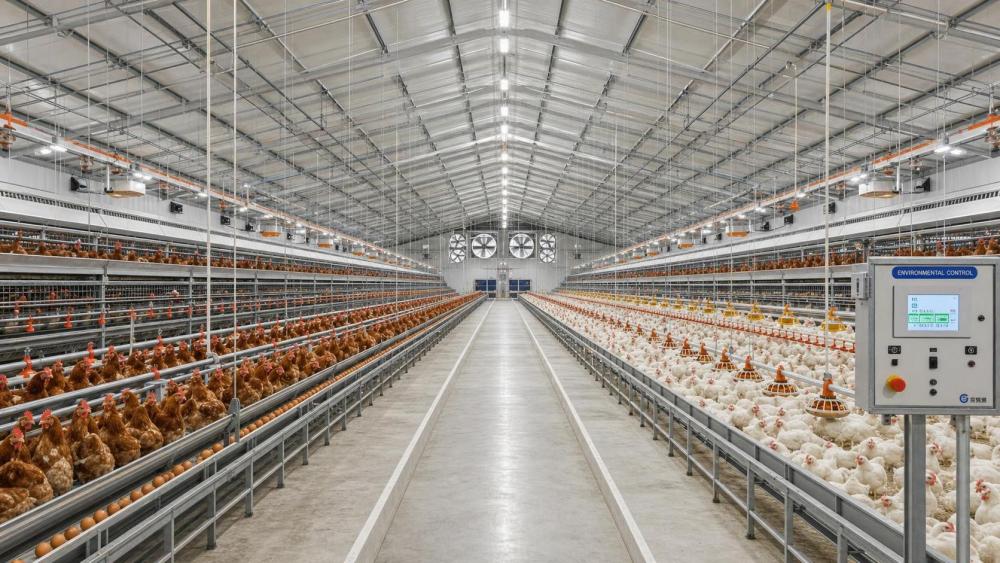
Layer and broiler projects share core infrastructure needs, but the planning logic is not the same. Broiler houses are typically centered on rapid growth, feed efficiency, environmental stability, and easy turnover between flocks. Equipment layout therefore needs to support uniform access to feed and water, strong ventilation control, and efficient litter or manure management, depending on the production model. Since broilers are harvested in relatively short cycles, cleaning speed and reset efficiency often become major operating priorities.
Layer houses are usually planned for a longer production period, which means equipment durability, egg collection flow, bird access behavior, and routine serviceability play a larger role. A small design mistake in a layer house can repeat every day for many months, affecting labor intensity and product quality over time. For that reason, project teams usually need to pay close attention to cage or floor system layout, feeder access, drinker line positioning, manure removal scheduling, and the movement path for eggs from collection point to storage.
This difference in production rhythm means equipment cannot be selected from a generic checklist alone. The same house dimensions may require different line density, control systems, and support components depending on whether the target is broiler growth or table egg production.
Key Planning Factors Before Equipment Selection
Before choosing any brand or configuration, decision-makers usually benefit from clarifying several site-specific questions. These points shape whether a proposed setup is realistic in operation rather than just technically possible.
- House type and bird density: floor system, cage system, open-sided house, or closed house design all influence equipment compatibility.
- Climate and ventilation demands: temperature swings, humidity, and dust levels affect fan requirements, cooling support, and equipment wear.
- Water and power conditions: poor water quality may shorten drinker performance, while unstable electricity may require backup planning for ventilation and feed delivery.
- Labor availability: highly manual systems may appear economical initially but create operating strain if trained labor is limited.
- Cleaning and biosecurity routines: equipment that is hard to wash, inspect, or maintain can increase disease management pressure over time.
- Expansion expectations: farms planning future phases should consider whether the control logic and physical layout can scale without major redesign.
These planning factors are especially relevant for engineering teams and distributors because they affect not only product matching, but also transport planning, installation sequencing, after-sales support, and spare parts strategy. A technically sound equipment package can still become a difficult project if those practical constraints are ignored early.
What a Complete Poultry Equipment Setup Usually Includes
A complete poultry house setup is usually built around a coordinated system rather than stand-alone items. In both layer and broiler applications, the core list often includes feeding lines, drinking lines, environmental control equipment, ventilation components, lighting arrangement, and supporting control units. Depending on the project, manure removal systems, egg collection systems, brood heating support, medication dosing, and alarm functions may also be part of the plan.
For project managers, one useful evaluation method is to separate the equipment list into three categories: production-critical items, operating-support items, and maintenance-risk items. Production-critical items include feeders, drinkers, and ventilation devices because they directly affect bird performance. Operating-support items include controls, regulators, line winches, and mounting components that influence consistency and ease of management. Maintenance-risk items include parts likely to wear, clog, corrode, or fail under local conditions. This structure helps procurement teams compare proposals with better clarity.
Where planners are assessing plasson poultry equipment within a broader farm design process, the more useful question is not whether a single product appears advanced, but whether the total configuration supports the intended management model. That includes compatibility between feed delivery, water access, pressure regulation, house dimensions, service aisles, bird movement, and the speed of routine inspection by staff.
Common Mistakes in Poultry House Equipment Planning
One common mistake is selecting equipment too late, after the building structure is already fixed. This can force compromises in line spacing, ceiling height, drainage slope, ventilation openings, or electrical routing. In many cases, the result is a house that technically operates but requires more labor and delivers less uniform flock performance than expected.
Another frequent issue is over-focusing on nominal capacity while underestimating maintenance conditions. For example, a feeding or drinking system may match the bird count on paper, yet become difficult to adjust or clean in daily use. Similarly, ventilation equipment may be properly sized but poorly positioned relative to inlets, resulting in uneven air movement and avoidable stress on birds.
Procurement teams also sometimes compare proposals without aligning the scope. One supplier may quote only core lines, while another includes regulators, suspension hardware, control accessories, and service parts. Without a full equipment breakdown, price comparisons can become misleading. This matters for distributors and agents as well, because unclear specifications often create disputes after delivery rather than during the evaluation stage, when corrections are easier to make.
Practical Selection Points for Layers and Broilers
For broiler houses, buyers often focus on drinker reliability, feeder pan accessibility, line height adjustment, and compatibility with ventilation patterns. Since broilers require uniform access during rapid growth, even distribution across the floor area is critical. Equipment that interferes with walking space, creates wet spots, or complicates litter management can reduce the overall value of the system even if the individual components seem acceptable.
For layer houses, teams may place greater weight on long-term structural durability, egg handling flow, manure management method, and the ease of inspecting feed and water performance across rows. In long-cycle operations, the cost of repeated maintenance interruptions can become more significant than a modest difference in initial purchase price. That is why many buyers review material quality, corrosion resistance, moving-part complexity, and spare part accessibility with unusual care.
What Project Teams Should Confirm with Suppliers
For engineering leads and commercial buyers, supplier discussions should go beyond model names and unit counts. It is usually worth confirming whether the proposed system is based on the actual house width, length, bird quantity, management style, and utility conditions. A credible setup plan should show how the equipment integrates into daily operation, not just how it fits inside the building.
Useful confirmation points often include:
- Whether the equipment list includes all required accessories and installation components
- How the system handles cleaning, adjustment, and replacement of wear parts
- What assumptions were made about water pressure, power supply, and house environment
- Whether installation guidance matches local construction capability
- How future capacity expansion could be supported
This level of review helps reduce procurement risk, especially in cross-border projects or in markets where replacement parts may take time to arrive. For distributors and agents, it also improves customer trust because the conversation moves from simple quoting toward practical project suitability.
A More Useful Way to Evaluate Equipment Value
In poultry house planning, value is rarely defined by low price alone. A more useful approach is to evaluate the relationship between equipment design, flock management efficiency, expected service life, and the cost of disruption when systems fail or require constant manual correction. This is particularly relevant in larger farms, where small operating inefficiencies multiply quickly across multiple houses.
For many buyers, the strongest solutions are those that align house design, equipment layout, and management routine from the start. That usually leads to fewer installation changes, better day-to-day oversight, and more predictable operating results. In both layer and broiler projects, a complete poultry farm equipment list and setup plan should therefore be treated as part of production strategy rather than a late-stage purchasing formality.
As poultry operations pursue better consistency and tighter cost control, equipment planning will remain a central decision point. Farms that review technical fit, maintenance reality, and long-term operating logic together are generally in a stronger position to build houses that support stable output instead of creating avoidable management pressure later.
Related News
- Homemade Laying Hen Cages: Materials, Dimensions, and Safety ChecksSep 07, 2026Como hacer jaulas para gallinas ponedora caseras: explore safe materials, practical dimensions, ventilation, egg hygiene, and essential checks for a reliable setup.
- Flat Deck Cage System vs Battery Cage: What Changes in Layer ManagementAug 24, 2026Flat deck cage system vs battery cage: discover how visibility, ventilation, manure handling, egg collection, and labor efficiency change layer management before you buy.
- How to View Poultry Equipment Details for 1,000-Bird Layer House PlanningJul 31, 2026View poultry equipment details for 1,000-bird layer house planning. Learn how layout, dimensions, feeding, watering, ventilation, and manure handling affect efficiency, cost control, and smarter project decisions.
- Plasson Poultry Equipment in Layer and Broiler House PlanningJul 27, 2026Plasson poultry equipment planning for layer and broiler houses: explore layout, ventilation, feeding, and maintenance tips to build efficient, reliable poultry operations.