




Search
Related News
- 00
0000-00
What a life sciences market trends report reveals about R&D spending - 00
0000-00
When does food processing require 316 instead of 304 stainless steel? - 00
0000-00
Global Wheat Prices Fall as Black Sea Supply Increases - 00
0000-00
A guide to choosing agri-food solutions for farm-to-fork traceability - 00
0000-00
How farm size affects agricultural innovation adoption in Europe
Tags
When does hygienic dairy equipment need aseptic capability?




Hygienic dairy equipment needs aseptic capability when the production process must preserve commercial sterility between a validated microbial treatment and the closure of the final package. This is typically the case for low-acid dairy products intended for ambient storage when the product and packaging are sterilized separately. Cleanable equipment alone cannot protect treated product from contamination introduced through a valve seal, tank vent, ingredient connection, or filling nozzle.
Refrigerated milk, cultured products, and dairy products sterilized inside their final containers can require different equipment strategies. The decision starts with the preservation method and the contamination risks after treatment. A longer shelf-life target, a stainless-steel construction, or a UHT heating stage does not independently establish that a line is aseptic.
Start with the product’s preservation strategy
Hygienic design allows equipment to be cleaned effectively and helps control contamination during production. Aseptic capability adds the ability to establish and maintain a commercially sterile product path under defined operating conditions. Commercial sterility does not mean the absolute absence of every microorganism; it concerns organisms capable of growing in the product under its intended storage conditions, alongside the relevant food-safety requirements.
That distinction changes the purchasing decision. A pasteurized product kept under refrigeration relies on a combination of treatment, contamination control, temperature management, and a defined shelf life. An ambient-stable, low-acid dairy product produced through aseptic processing depends on a validated sterilization treatment and protection against recontamination until its package is sealed.
Extended-shelf-life production deserves particular care. The term describes an intended outcome and can cover different processing and filling arrangements. Ask suppliers to identify the actual microbial control strategy. A hygienic filler, an ultra-clean filler, and an aseptic filler should not be treated as interchangeable simply because each is offered for refrigerated dairy products.
Define where the sterile boundary begins and ends
Once aseptic processing is required, map every product-contact surface from the final validated sterilization stage to package closure. Depending on the layout, this may include downstream cooling equipment, homogenization, holding vessels, transfer pumps, valves, sampling points, ingredient dosing, and the filler. Any component inside this boundary must support its establishment and continued protection.
The location of a component matters as much as its name. A homogenizer upstream of the final microbial treatment has a different duty from one downstream. A balance tank handling raw milk does not need the same protection as an aseptic buffer tank holding commercially sterile product. Specifying every component as aseptic can add cost without improving the relevant control; leaving one downstream connection unprotected can compromise the entire process.
Draw the boundary on the process diagram and mark every point where product, air, utilities, or equipment movement could introduce contamination. Include routes used only during startup, sampling, changeover, and maintenance. These connections are easy to overlook when reviewing the main production flow.
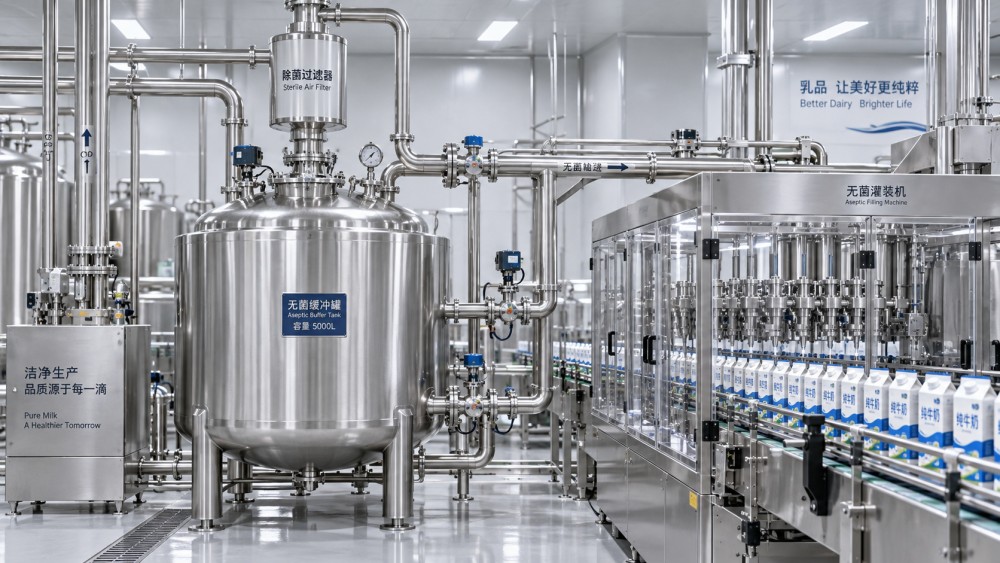
Late ingredient addition is especially consequential. A flavor, vitamin preparation, or other ingredient dosed after sterilization must enter through an appropriately validated treatment and aseptic addition system. Some liquids may be suitable for sterilizing filtration; suitability depends on their composition and filterability. Powders, emulsions, and particulate ingredients require their own assessment. A sanitary dosing pump cannot make an untreated ingredient commercially sterile.
What hygienic dairy equipment must demonstrate for aseptic service
Cleaning and sterilization must both work
Clean-in-place, or CIP, removes product residues and soil. Sterilization establishes the required microbial condition before production. These functions support each other: deposits can shield microorganisms and interfere with treatment, while a successful cleaning cycle alone does not establish commercial sterility.
Equipment must tolerate and effectively receive the selected sterilization process. Steam is one option, but hot water or chemical methods may be appropriate for particular systems and packaging operations. The relevant question is whether the method reaches all required surfaces under validated conditions. An “SIP-ready” description is insufficient without its operating limits, cycle requirements, and installation assumptions.
Evaluate drainability, trapped air, condensate removal, and difficult-to-reach spaces. Valve cavities, instrument connections, and seal areas can behave differently from the main pipe during sterilization. Smooth surfaces help cleaning, but they do not demonstrate that every location receives an adequate microbial treatment.
Seals and barriers must remain effective during operation
Pump shafts, valve stems, tank vents, and moving filler components create interfaces between the protected product path and its surroundings. Appropriate designs may use steam barriers, sterile gas, specialized seals, or other validated arrangements. The selection depends on the component’s movement, pressure conditions, and sterilization method.
Request an explanation of how each barrier functions during production and how failure is detected. A barrier that works only under steady pressure may become vulnerable during a stop, vacuum condition, or product changeover. Seal materials must withstand the actual combination of product exposure, cleaning chemicals, sterilization, and repeated cycling.
For tanks supplied with sterile gas, assess the filtration system, housing, sterilization arrangements, and integrity-testing provisions. Positive pressure can support protection, but pressure alone does not establish that incoming gas is suitable or that all possible entry routes are controlled.
The control system must protect the process state
Aseptic capability includes the sequence of operations and the response to abnormal conditions. The system should prevent product from entering an unprepared downstream path and prevent filling before the required sterilization conditions have been met.
Evaluate how the controls respond to inadequate treatment conditions, loss of a sterile barrier, power interruption, and restart. Product diversion, segregation, or shutdown must follow the defined process logic. Useful records show whether critical conditions were maintained and make deviations traceable. A display showing “sterile” has little value unless the conditions behind that status are clear.
Match the specification to the hardest product and operating condition
A line designed around plain milk may not suit a thick dairy dessert or a formulation containing particles. Viscosity affects flow and heat transfer. Particles complicate treatment uniformity. Proteins, minerals, and other ingredients influence fouling, which can alter heat transfer and limit production duration.
Specify the product range rather than one nominal recipe. Include relevant variation in solids, fat, viscosity, particle characteristics, acidity, and ingredient stability. Where a supplier proposes sterilizing filtration, establish whether the material can pass through the selected filter without unacceptable changes or blockage.
Operating flexibility also needs scrutiny. Reduced throughput, temporary holding, recirculation, and transitions between products can change thermal exposure and pressure relationships. A system validated for steady production may need additional evidence for these conditions. The proposed production schedule should therefore inform the validation scope.
Aseptic processing controls microbial risk, but it does not guarantee acceptable flavor, physical stability, or nutrition throughout storage. Excessive thermal exposure can affect quality, while oxygen and light exposure may remain relevant after filling. Select the treatment and package together so that microbial preservation and product quality support the same shelf-life target.
Assess the filler and packaging as part of the same system
A commercially sterile product can be compromised at the final filling step. Packaging material, closures, filling surfaces, and the protected filling environment must operate as a coordinated system. The transfer connection between processing equipment and the filler also belongs within the aseptic assessment.
Package sterilization requires more than the presence of a sterilant application device. The process must deliver suitable exposure to relevant surfaces while controlling residues and maintaining packaging performance. Package geometry, material compatibility, closure design, and handling can affect the result.
After sealing, package integrity protects the product through storage and distribution. A successful sterilization cycle cannot compensate for a seal that develops leaks. Include the intended handling conditions and package-integrity evaluation in the overall project scope.
If the preservation strategy instead uses sterilization after the container is sealed, the equipment priorities shift toward reliable filling, closure formation, container suitability, and the validated final treatment. This distinction should be settled before comparing aseptic filling quotations.
Ask for evidence that applies to the installed line
Certificates and equipment descriptions can support an assessment, but they do not establish the performance of a complete installation. Hygienic design credentials do not automatically demonstrate aseptic capability. Likewise, evidence for an individual valve or filler does not cover every pipe, utility connection, control sequence, and product used in the assembled system.
A useful supplier submission should make the operating envelope and validation responsibilities explicit. Request evidence covering:
- The product and process range: formulations, throughput conditions, and treatment assumptions included in the proposed solution.
- Cleaning and sterilization: cycle definitions, acceptance criteria, monitoring points, and the basis for identifying difficult locations.
- Protection during production: barrier arrangements, utility requirements, integrity checks, and permitted operating states.
- Deviation handling: actions following treatment failure, barrier loss, unplanned stops, and restart.
- System integration: responsibility for connecting the processing line, ingredient systems, buffer storage, filler, and packaging validation.
Validation should address the actual installation and representative operating conditions, including appropriately selected worst cases. Finished-product incubation and microbiological testing can contribute evidence, but sampling alone cannot demonstrate that every unit was processed correctly. Reliable assessment combines process measurements, appropriate challenge work, equipment checks, and documented operating controls.
Choose aseptic capability where the preservation strategy requires it
Aseptic equipment brings additional demands for utilities, instrumentation, maintenance, operator training, and recovery after interruptions. Those demands are justified when maintaining commercial sterility is essential to the chosen product and distribution model. For a refrigerated pasteurized product, improvements in hygienic design, filling hygiene, and cold-chain control may address the actual limitation more directly.
Future flexibility can justify provisions for an aseptic upgrade, but the physical requirements should be identified early. Sterilizable components, compatible seals, protected connections, utility capacity, and filler integration cannot always be added through a later software change.
Before requesting quotations, prepare a short process brief defining the product range, storage conditions, shelf-life target, preservation route, downstream additions, and expected operating pattern. Mark the sterile boundary where one is required and assign responsibility for validating the complete system. That brief turns “aseptic capability” into a reviewable requirement and allows equipment proposals to be compared on the conditions they can actually support.
Related News
- When does food processing require 316 instead of 304 stainless steel?Oct 18, 2026Food Engineering stainless steel guide: Discover when 316 or 316L outperforms 304 in salty, acidic, or hot processes—and make smarter equipment choices to reduce corrosion risks.
- When does hygienic dairy equipment need aseptic capability?Oct 18, 2026When does hygienic dairy equipment need aseptic capability? Explore sterile boundaries, filling risks, and validation essentials to choose the right system for your dairy process.
- How to assess drainability when choosing hygienic process equipmentOct 17, 2026Choosing hygienic process equipment? Learn how to assess drainability, spot hidden liquid traps, and verify supplier claims to reduce contamination risks and improve changeovers.
- Can rotary jet technology cut water use in beverage tank cleaning?Oct 15, 2026Discover how beverage tank cleaning technology with rotary jets can reduce water use through verified coverage and optimized cycles without compromising hygiene.